

Categories
Tags
2025 Active-Directory Adobe ColdFusion Apache ASP DotNet Aug 2024 AWS B2R Binary Binary Hijacking Broken Access Control Burpsuite Caido Clickjacking Cloud Crackmes Cryptography CVE-2009-3548 CVE-2014-1812 CVE-2024-28397 CVE-2024-32019 CVE-2025-24893 Debugging Easy Email-Forensics Engineering Eternal Blue Exploitation Feb File-upload-vulnerabilities Flare-On Forensics Free FTP HACK HAVOC HTB HttpFileServer IDA IIS impacket Industrial-Control-System Information Disclosure js2py KPMG Linux Malware-Analysis Metasploit Microsoft-Access-database Misc Mobile MS10-092 MS14-025 MS16-032 MS17-010 npbackup nsudo Oct 2024 Operational-Technology OSINT Path-Injection Path-Traversal-To-RCE PMA_Labs Programming PwnedLabs RCE Retired Reverse Reverse Engineering Reversing Runas-Abuse S3 S3-to-AccountID Scripting Sherlock SMB Snyk SSRF Steg Telnet Tomcat VIP Web Windows x64dbg xwiki
605 words
3 minutes
Flare-On 2015 March 2026

- Category: Malware Analysis and Reverse Engineering
- Difficulty: Easy/Medium/Hard
- File: 2014_FLAREOn_Challenges.zip
Challenge 1:
Stage 1 Extracting CAB File
Initial Triage
- File Type: PE32+ executable for MS Windows 5.02 (GUI), x86-64
- Size: 183KB
- SHA256: a0b3e6ab4a53bf745319177035017f222634d2601ba8708292d5fbe440467387
Basic Static Analysis
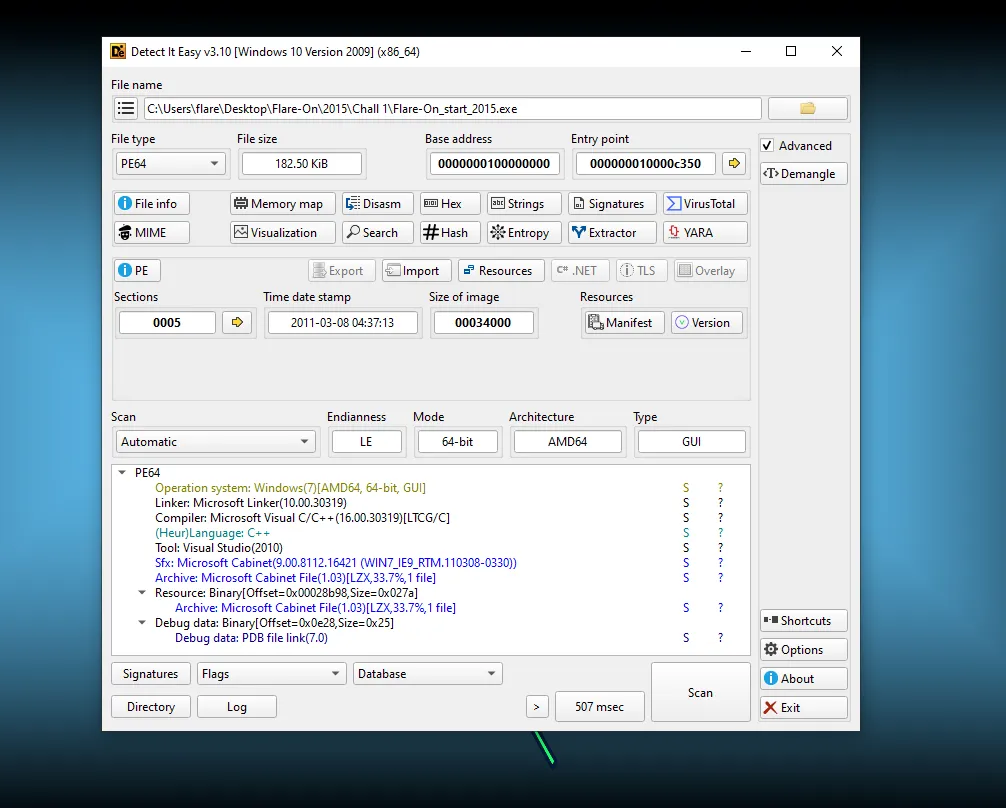
- Detect it Easy (Die) show that this file is self-extracted CAB/SFX style packing, where the executable includes a compressed Microsoft Cabinet file (CAB) and extracts/executes it at runtime and it is just a wrapper/loader.
- The
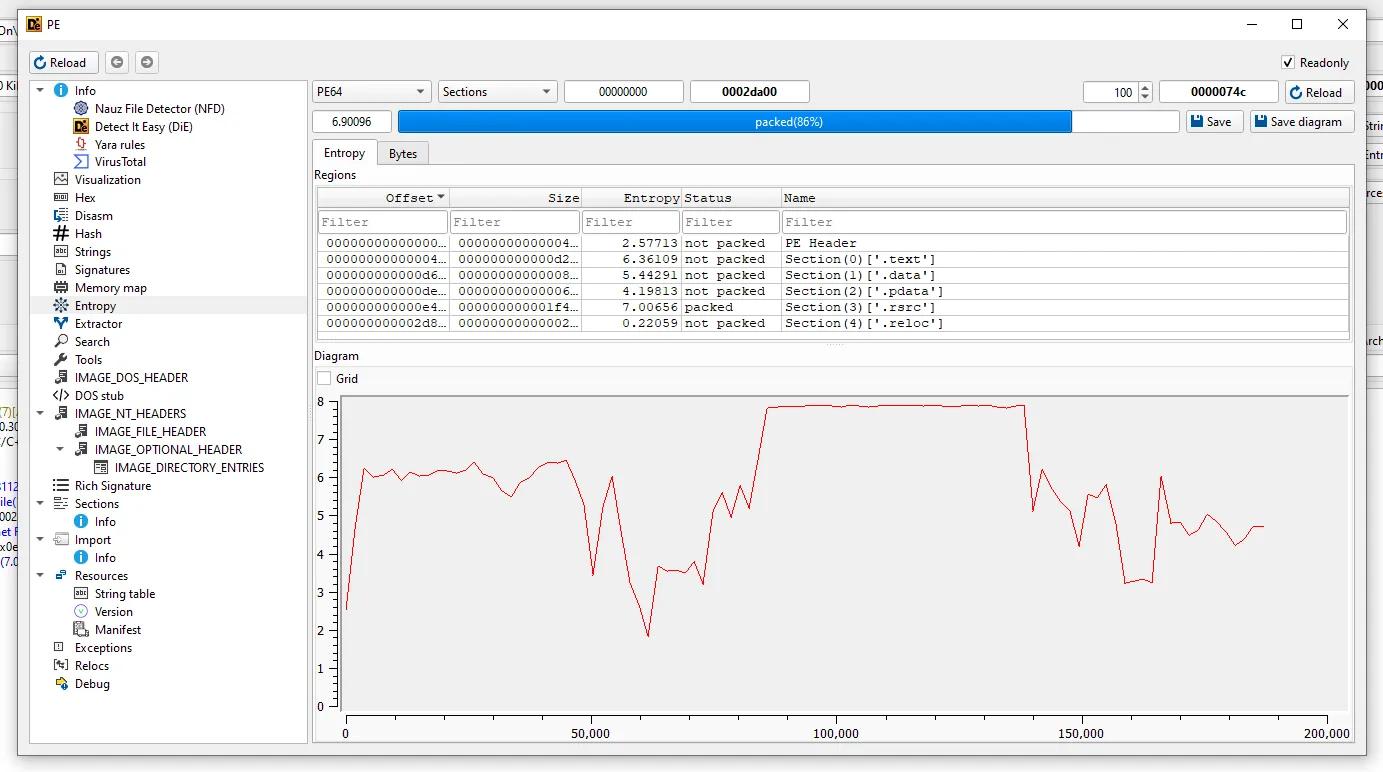
.rsrcsection is compressed, which is why the tool flags high entropy, classic sign of packing or encryption. - Compression algorithm used inside the CAB is LZX (as shown), which is common in Microsoft CAB archives.
- So we have to first extract the actual exe from this and analyze it,
- We can extract it using cabextract tool, and it will written in
Flare-On_start_2015.exefile,
┌──(b14cky㉿DESKTOP-VRSQRAJ)-[~/]
└─$ cabextract Flare-On_start_2015.exe
Extracting cabinet: Flare-On_start_2015.exe
  extracting i_am_happy_you_are_to_playing_the_flareon_challenge.exe

All done, no errors.
Stage 2 Understanding the ASMx86 Compiled EXE
Initial Triage
- File Type: PE32 executable for MS Windows 4.00 (console), Intel i386
- Size: 2KB
- SHA256: 5d35789ac904bc5f4639119391ad1078f267a157ca153f2906f05df94e557e11
Basic Static Analysis
- It gives
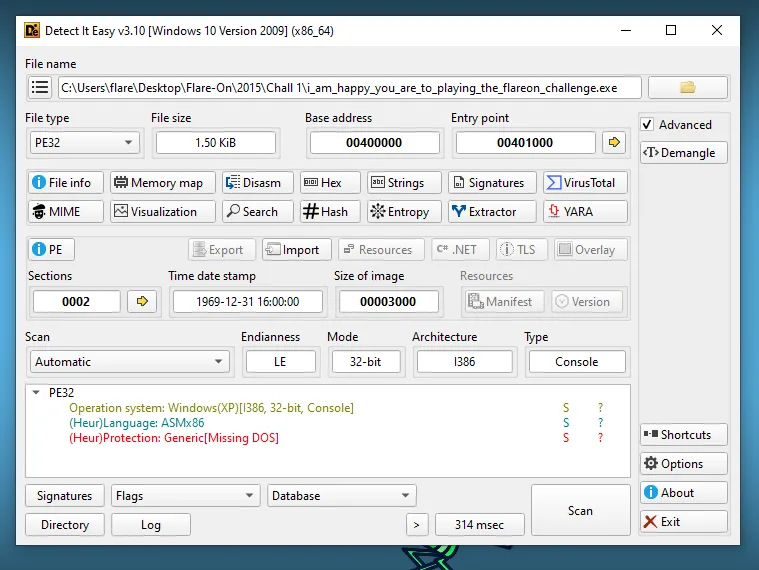
i_am_happy_you_are_to_playing_the_flareon_challenge.exe. - By running
dieon it, and it is written in assembly, not C/CPP. - Also, it has missing DOS Header which means most of the automatic tools fail here because of these setup.
- Running
flossfor strings analysis,
┌──(b14cky㉿DESKTOP-VRSQRAJ)-[~/]
└─$ /opt/floss i_am_happy_you_are_to_playing_the_flareon_challenge.exe
.
.
.
 ───────────────────────────
  FLOSS STATIC STRINGS (18)
 ───────────────────────────

+----------------------------------+
| FLOSS STATIC STRINGS: ASCII (18) |
+----------------------------------+

.text
.data
Pj*h
Pj2hX!@
h.!@
kernel32.dll
LoadLibraryA
GetProcAddress
GetLastError
GetStdHandle
AttachConsole
WriteConsoleA
WriteFile
ReadFile
Let's start out easy
Enter the password>
You are success
You are failure

+------------------------------------+
| FLOSS STATIC STRINGS: UTF-16LE (0) |
+------------------------------------+
 ─────────────────────────
  FLOSS STACK STRINGS (0)
 ─────────────────────────
 ─────────────────────────
  FLOSS TIGHT STRINGS (0)
 ─────────────────────────
 ───────────────────────────
  FLOSS DECODED STRINGS (0)
 ───────────────────────────
- These are the the
kernel32.dllAPIs, - It can be used for Dynamic API Resolution + I/O Execution Flow. (Just a hypothesis)
LoadLibraryA
GetProcAddress
GetLastError
GetStdHandle
AttachConsole
WriteConsoleA
WriteFile
ReadFile
- Something related to password/licence checking,
Let's start out easy
Enter the password>
You are success
You are failure
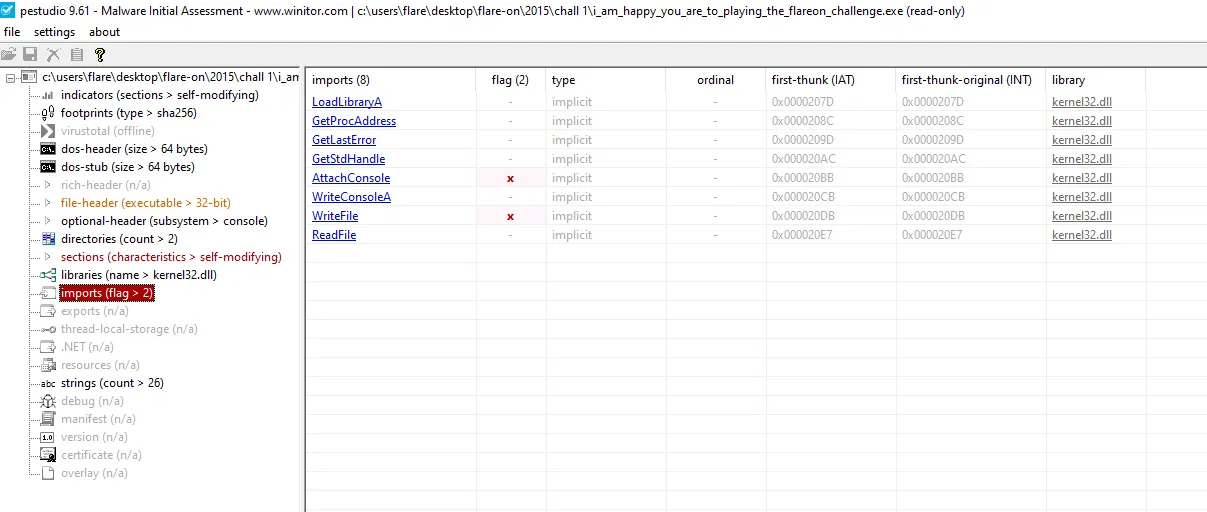
- Now, to confirm the imports i used
pestudioand indeed it is using those,
Advance Static Analysis
- So, to analyze it opened it in IDA with manual load because sometimes auto load fails in these kind of binaries, and found that it has only one
startfunction is which is doing something,
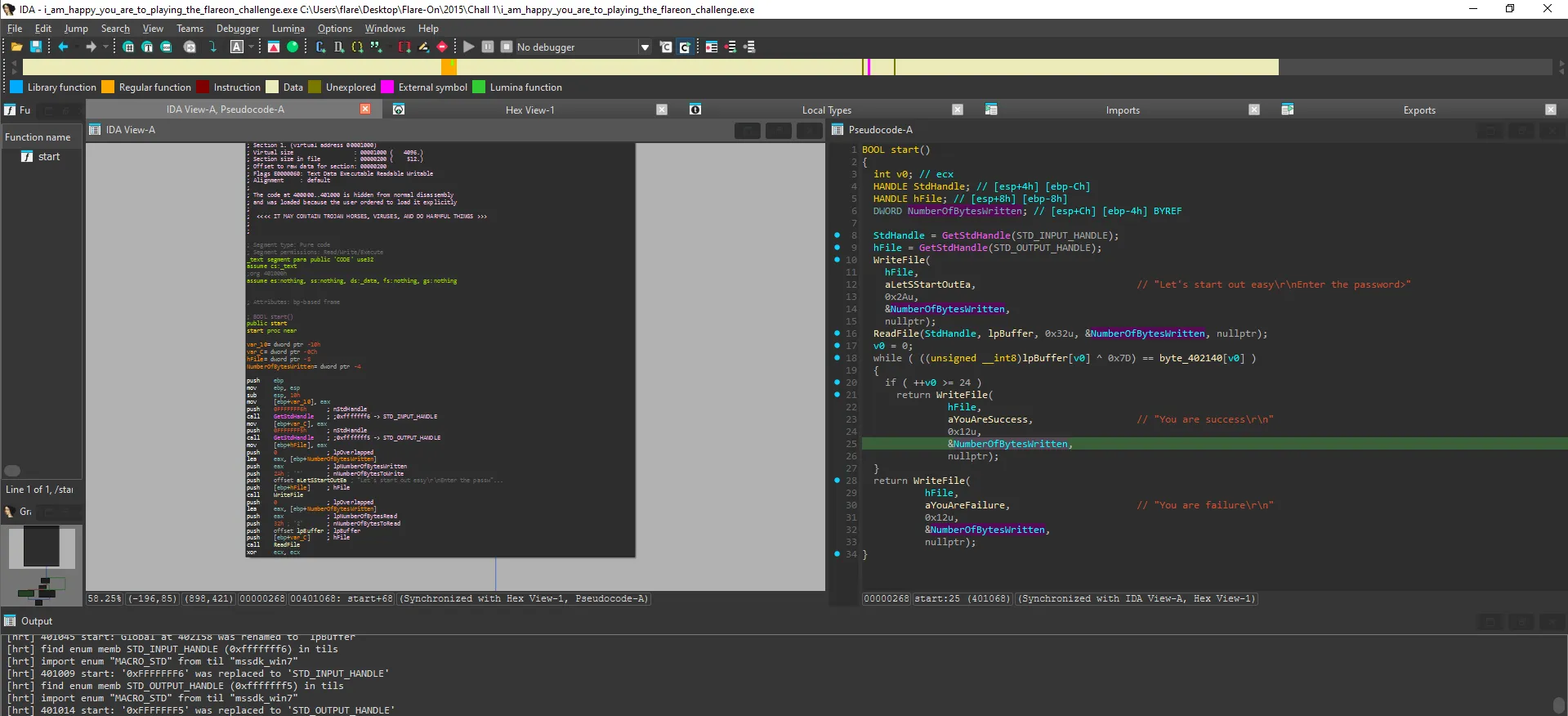
GetStdHandle()is called with: -STD_INPUT_HANDLE→ stdin -STD_OUTPUT_HANDLE→ stdout- Return values (in
EAX) are saved as handles for input/output.
- Return values (in
- I/O Operations
WriteFile()→ prints prompt to console (stdout)ReadFile()→ reads up to 50 bytes intoinput_buffer(0x402158)
BOOL start()
{
  int v0; // ecx
  HANDLE StdHandle; // [esp+4h] [ebp-Ch]
  HANDLE hFile; // [esp+8h] [ebp-8h]
  DWORD NumberOfBytesWritten; // [esp+Ch] [ebp-4h] BYREF

  StdHandle = GetStdHandle(STD_INPUT_HANDLE);
  hFile = GetStdHandle(STD_OUTPUT_HANDLE);
  WriteFile(
    hFile,
    aLetSStartOutEa,                            // "Let's start out easy\r\nEnter the password>"
    0x2Au,
    &NumberOfBytesWritten,
    nullptr);
  ReadFile(StdHandle, lpBuffer, 0x32u, &NumberOfBytesWritten, nullptr);
  v0 = 0;
  while ( ((unsigned __int8)lpBuffer[v0] ^ 0x7D) == byte_402140[v0] )
  {
    if ( ++v0 >= 24 )
      return WriteFile(
               hFile,
               aYouAreSuccess,                  // "You are success\r\n"
               0x12u,
               &NumberOfBytesWritten,
               nullptr);
  }
  return WriteFile(
           hFile,
           aYouAreFailure,                      // "You are failure\r\n"
           0x12u,
           &NumberOfBytesWritten,
           nullptr);
}
- Expected C code,
for (i = 0; i < 24; i++) {
    if ((input[i] ^ 0x7D) != encoded[i]) {
        print("failure");
        return;
    }
}
print("success");
Here is the flow of code,
- Print prompt
- Read input
- For each character:
- XOR with
0x7D - Compare with stored value
- XOR with
- If all 24 match → success
- Else → failure
This are the sequence of bytes which are being XORed with key
0x7D.
1F 8 13 13 4 22 0E 11 4D 0D 18 3D 1B 11 1C 0F 18 50 12 13 53 1E 12 10
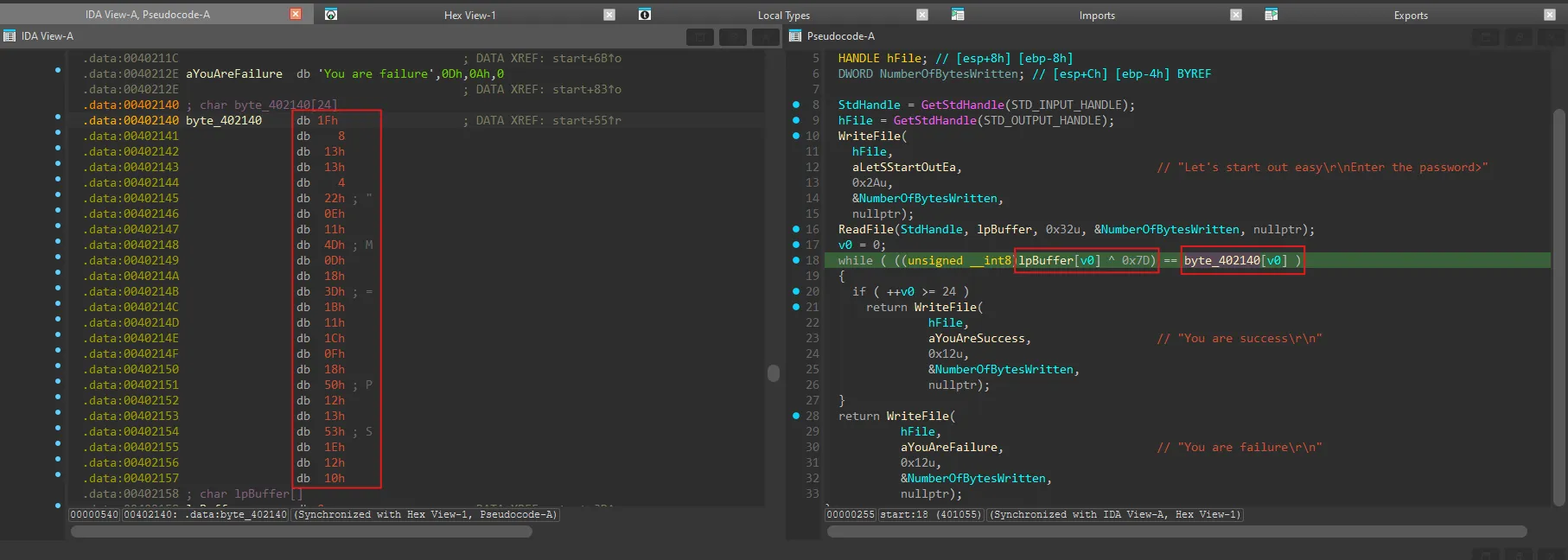
- Got the flag!!
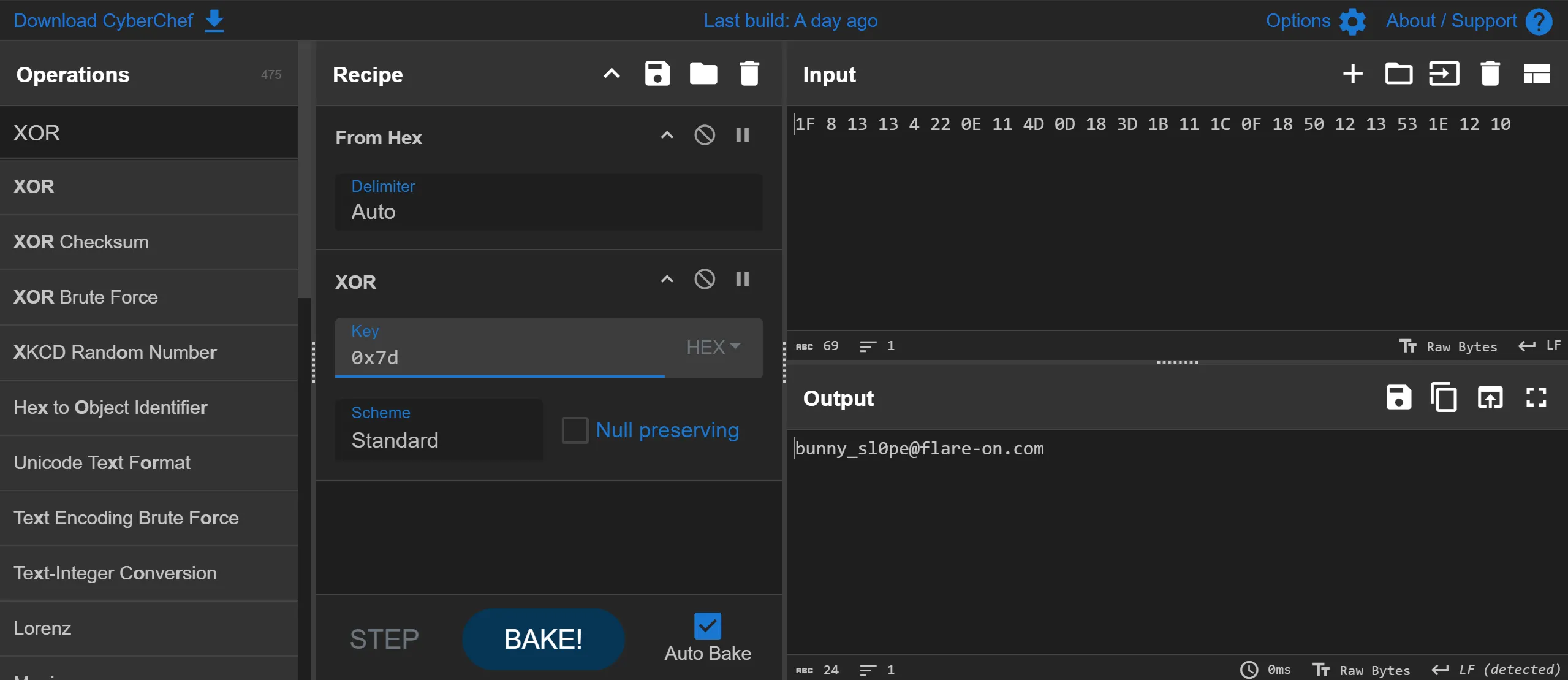
bunny_sl0pe@flare-on.com
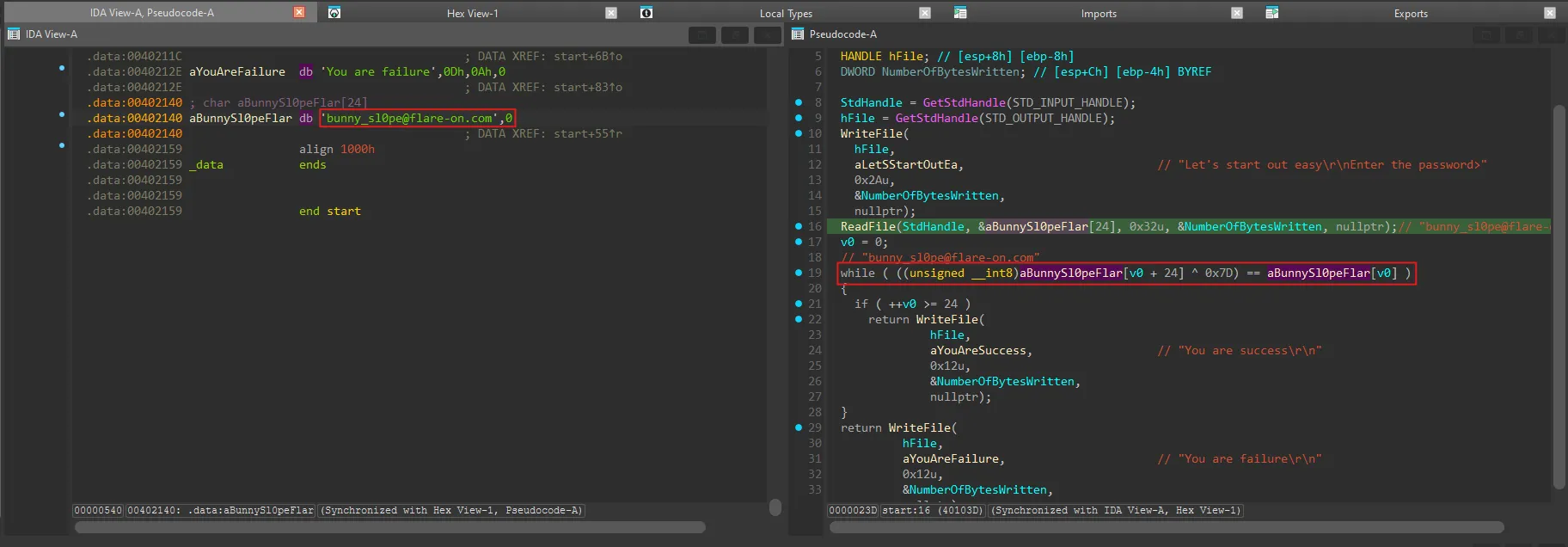
- You can also apply this
IDApythonscript which will manually patch the bytes, (only for IDA pro).
import idc

for i in range(0x00402140, 0x00402158):
    b = 0x7D ^ idc.get_wide_byte(i)
    idc.patch_byte(i, b)
Flare-On 2015 March 2026
https://b14cky.github.io/posts/flare-on-2015/notes/